Showing posts with label Love. Show all posts

Wednesday, November 18, 2015

To Welcome or Not to Welcome?

TITLE: TO WELCOME OR NOT TO WELCOME?
SCRIPTURE: 1 John 4:18
Written by: Dr Conrade Yap
Date: 18 November 2015

18There is no fear in love. But perfect love drives out fear, because fear has to do with punishment. The one who fears is not made perfect in love." (1 John 4:18)

The Paris attacks last week easily consume the front pages of most major dailies around the world. With sensational reporting and graphic pictures, followed by commentaries and opinion pieces, everyone have heard at least something about it: Terrorism in France.

Hundreds of people died, mostly French. By targeting at key popular spots such as soccer stadiums, restaurants, cafes, concert halls, etc, the objective of the co-ordinated attacks is to instill fear and a sense of insecurity among the people. It has partial success. As Parisians grapple with a world that would never be the same again, they realize that safety and security cannot be taken for granted. Flowing tears of grief are mixed with growing fears of new threats that could come anytime, anywhere, and to anyone. These fears resulted in more counter-terrorist actions. The next day, France launched one of the largest assaults at terrorist targets in war-torn Syria. Today, anti-terrorist forces continued their hunt for the masterminds of last Friday's attacks. As world leaders and community groups come together to pray for France, social media is filled with notes of love with #PrayForParis.

At the France-England friendly soccer match yesterday, although England won 2-0, the result did not matter. The highlight was not the soccer game but the events before the game. United as one people, both French and English national anthems were sung by all in the stadium, including a sizeable number of French in the crowds. It is a show of unity and defiance against terror, saying that good will always triumph over evil. Everywhere we go, we see the French flag colours of red, white, and blue across monuments, buildings, and public events. The social media titan, Facebook has even made it easier for users to create French coloured backgrounds for them to express their sharing of grief and their solidarity with the French people.


Tuesday, October 13, 2015

Gospel-Led Living

TITLE: GOSPEL-LED LIVING
SCRIPTURE: Ephesians 5:15-17
Written by: Dr Conrade Yap
Date: October 13th, 2015


"15Be very careful, then, how you live—not as unwise but as wise, 16making the most of every opportunity, because the days are evil. 17Therefore do not be foolish, but understand what the Lord’s will is." (Ephesians 5:15-17)


KEY THOUGHT: Gospel-Led living is not just for a small part of our lives. It is for ALL of our lives.

Busy. Not enough time. Too much to do. Familiar?

It is all too familiar. Whether one is working at a Full-time job or otherwise, being busy makes a typical adult person maintains feelings of fulfillment.  As long as I make the money for the family, I fulfill my financial obligation. As long as I spend time with my children, I fulfill my parental obligation. As long as I keep my hours in my office, I fulfill my employment obligations. As long as I serve in some capacity in Church, I fulfill my spiritual obligations.

What if something's gotta give? What if we spend more time in one at the expense of another? What if we totally miss out on an important obligation? Will our lives become less fulfilling?

Dietrich Bonhoeffer writes: "Every Christian must be fully Christian by bringing God into his whole life, not merely into some spiritual realm." This speaks into some people who separate the sacred from the secular, believing that they are only serving God when they are in churches or doing Bible related stuff.

This week, I like to share about productivity and how we can let the gospel drive our living. It is not about using the gospel to be better at our jobs. It is letting the gospel motivate us in our work. Christians do not just do good in the world. They do good in such a way that people notice God working in their lives. They serve faithfully not because they are obligated to. They serve because they loved to. We don't simply try to do our best to love our families. We love our families and are grateful every time we get to love our families. We serve in churches not because there is a desperate need for volunteers. We serve because it is an opportunity to exercise the gifts God has given us.

A) "Be very careful, then, how you live"

A gospel-led life begins with an awareness of our surroundings, where we are, the environment we are living in, and who we are with. If it is with lots of non-Christians around, be careful about the language we use. It is not appropriate to use "Christianese" which they don't understand. Avoid using words that only Church-people understand. Talk in everyday language but refrain from profanities we often hear in the office. If possible, show your displeasure when colleagues spout out vulgarities. At the same time, maintain a careful leash on the tongue, not to slander, not to spread rumours, and not to gossip about rumours. Even when one has the facts, do not be too quick to let loose. Be careful about how the words impact others. Speak the truth in love. A gospel-led life is not about reviving our prosperities but resetting our priorities.


Monday, September 28, 2015

Humility in Service

TITLE: HUMILITY IN SERVICE
SCRIPTURE: Ephesians 4:2-3
Written by: Dr Conrade Yap
Date: Sep 27th, 2015

"2Be completely humble and gentle; be patient, bearing with one another in love. 3Make every effort to keep the unity of the Spirit through the bond of peace." (Ephesians 4:2-3)
Is it possible to be completely humble? Given our imperfect selves and our natural tendency to be prideful, how then can we ever follow through on Paul's call for us to be humble?

My quick answer: We can't. Not on our own strength that is.

(Credit: ThorstenConsulting)
Humility has been promoted highly at all kinds of leadership conferences. Gurus trumpet it. Writers publish volumes about it. Pastors and preachers regularly mention it over the pulpit. The trouble with humility is that it is elusive and quite difficult to achieve directly. It is an attribute that can only be seen indirectly through various means. The humble will deny he is humble in the first place. The one who claims he is humble is already on the track of pride and arrogance. This is one of life's irony. The more we want something directly, the less we get it. It is like romantic love where a man pursues a girl, only to find the girl running away from him. The moment the man stops pursuing, stops harassing the girl, and begins to do good works to others, the girl would stop running. She would turn around and with piqued interest, find ways to connect with this "nice man." If humility is that desired damsel, we cannot be too overpowering in our pursuit. We need to take a step back and check our own hearts.
  • Am I seeking humility for my own sake or for others?
  • Am I seeking to be humble in order to gain someone or something for self gratification?
  • Am I seeking the humble route because I want to honour Someone?

According to Professor John Dickson of Macquarie University, humility is defined as follows:
"Humility is the noble choice to forgo your status, deploy your resources or use your influence for the good of others before yourself. More simply, you could say the humble person is marked by a willingness to hold power in service of others." (John Dickson, Humilitas, Zondervan, 2011, p24)
In other words, humility comprises three elements: it presupposes the dignity of others; it is a choice; and it is self-deprecation for the sake of others.


Monday, July 6, 2015

The Four Quadrants of Love - 1 John 4:7-21

TITLE: THE FOUR QUADRANTS OF LOVE
SCRIPTURE: 1 John 4:7-21
Written by: Dr Conrade Yap
Date: July 6th, 2015

Love is a highly touted word in modern times. The Beatles sing “All You Need is Love.” Antiwar activists tout: “Make love, not war.” Religious groups use the idea of “love” to promote inter-religious tolerance and common activities. A lot of good have come out of the desire to celebrate love. A lot of controversies have also risen.

One of the most contested topics is the area of same-sex marriage. It has divided Churches. It has polarized policy makers throughout the West. It has split families and defied long-held traditions. Last week, I wrote about the way we can respond to the June 26th, 2015 SCOTUS decision that effectively legalized same-sex marriage throughout the fifty United States. Hailed as a landmark decision, while many celebrated, equally many lamented on the state of society now. Marriage has been expanded beyond the conventional understanding of male-female union. Now, every sex can marry any sex. It makes a mockery out of the word “marriage” as understood in Ephesians 5:31. In a society that allows the freedom of religious beliefs, atheists, secularists, and non-Christians in general would assert that the Bible does not apply to them because they do not believe. Moreover, they would say that Christians have no right to impose their faiths on a secular society.

Four Quadrants of Divine Love
Christians respond by saying, it is not a question of belief. It is about truth vs falsehood. It is not the Christian imposing anything, but God who will judge, regardless of whether people believe in Him or not. For the battle is not the Christian’s. It is the Lord’s. Everybody have a right to their own opinion, but not every opinion is right. People can be utterly sincere but also seriously wrong. Love too is a many-splendored thing, but it is also greatly misunderstood. Like the proverbial one man’s meat is another man’s poison, a person’s understanding of love is another expression of hatred. The Apostle John, sometimes called the Apostle of Love wrote in 1 John 4, that God is Love. He compares worldly love with divine love. Most importantly, love is not a concept or a nice idea. Love is in Jesus Christ. In such times where love seem to be all kinds of things to all kinds of people, it is good to just pause and reflect on what John has to say about love.

This week, I offer some reflections on 1 John 4:7-21, using what I call the “Four Quadrants of Divine Love.”


Monday, June 22, 2015

Forgiven but Never Forgotten

TITLE: FORGIVEN BUT NEVER FORGOTTEN
SCRIPTURE: 2 Corinthians 1:3-4
Written by: Dr Conrade Yap
Date: June 22nd, 2015

"3Praise be to the God and Father of our Lord Jesus Christ, the Father of compassion and the God of all comfort, 4who comforts us in all our troubles, so that we can comfort those in any trouble with the comfort we ourselves receive from God." (2 Cor 1:3-4)

It was a rough week for the city of Charleston, South Carolina, in particular, for the families of nine members of Emanuel African Methodist Episcopal Church, who were shot dead by a 21-year old white man. One hour into a regular Wednesday evening's Bible study, Dylan Roof, shot dead nine black members of the study group in cold blood. It was a murder cum massacre of the racist order. It was totally uncalled for and totally evil to the core. The crime was beyond anybody's wildest imagination and the act roundly condemned by all persons of every race and religion. Even the most hardened of hearts would have their consciences seared with pain and disbelief. After all, we are not talking about a war zone or some kind of a gangland battleground. It was a Church where the key "weapons" of warfare are not guns but prayers, not clenched fists but open arms, not hatred but love. That is what made the whole shooting such a mind-boggling event. On top of that, Roof was graciously invited to do a Bible study with the pastor among them. No one would have thought that welcoming a guest like Roof would turn into a vicious and bloody murder scene. Although Roof managed to escape and subsequently caught a day later, the nine who died never stood a chance and were ushered very suddenly into the presence of the Lord. How do we explain that?

A) Always a Mental Condition?

In cases this this, there are always some who would try to justify it from a psychiatrist's angle, pleading for leniency on the basis of a mental condition. Such is the approach done by Newsweek, that headlined the whole shooting event as follows: "Charleston Massacre: Mental Illness Common Thread for Mass Shootings." Like a skilled researcher, the report goes on to highlight seven previous cases of mental illnesses behind each mass shooting. The problem is, what if they are wrong? What gives them the sudden insight into the mind of this killer? Even mental health professionals are not entirely sure that every case is a mental puzzle in the first place. For us laypersons, who on earth does NOT have mental problems when under stress? How many people would not break under duress? Here's the problem. Who gives people the sudden inside scoop on all shootings to primarily psychology? In an age where people are innocent until proven guilty, what about their victims whom they have hurt before the final judgment? Don't they too have mental problems and scars? For all the attention dished out on the killer's welfare, what about the families of the victims?

Thursday, April 30, 2015

Praying Through Psalm 30 (For Nepal)

TITLE: PRAYING THROUGH PSALM 30 (For Nepal)
SCRIPTURE: Ps 30
Written by: Dr Conrade Yap
Date: April 30th, 2015
"I will exalt you, LORD, for you lifted me out of the depths and did not let my enemies gloat over me." (Ps 30:1)
(Photo Credit: BBC 2015)
O Lord, it's Nepal. What is happening there, You know best.
How do I exalt you in the midst of news like that? Can the wounded be lifted out of the depths?
Did the people of Nepal do something wrong to deserve all this disaster?
There is so much suffering and pain over there now. Lord, do something!
Let there be miracles in the midst of tragedy. Let there NOT the enemies of Nepal, wherever they are, gloat over the tragedy of Nepal.

"2Lord my God, I called to you for help, and you healed me. 3You, Lord, brought me up from the realm of the dead; you spared me from going down to the pit." (Ps 30:2-3)
Lord, You are able to help. Bring forth your compassion through the efforts of the nations who have pledged help. Enable them to send their best. Bring them from afar. Enlarge the capacity of the Nepali infrastructure to cope with the increased demand. Encourage the rescuers with good news. Heal the hurt. Strengthen the rescuers. Spare more lives. Let there be survivors who would call out, cry out, and shout aloud their location. Prevent more people from going to the pit.


Friday, October 10, 2014

Dealing with Negativity

TITLE: DEALING WITH NEGATIVITY
Written by: Dr Conrade Yap Date:10 October 2014

Christianity has an increasingly negative image problem. This is easily felt in the West, especially in North America. For Europe, the Christian influence has largely been erased from the minds of ordinary people. Even the ancient artifacts and grand structures of Christendom in Europe wow mostly visitors to Europe. In a post George W Bush era, I sense an even greater negativity against anything Christian in many parts of America and Canada.

Just this week, I read of a graduate from Trinity Western University, a private institution that is openly Christian, being rejected from a Norwegian company because she was deemed "unqualified." The rejection email was followed by sneers and jeers about her school, her God, and her faith. It is not only the rejection, but the harsh negativity of the prospective employers who claimed that it was Christianity that destroyed their culture. Feeling hurt and discriminated against, the plucky Bethany Paquette filed a complaint with the BC Human Rights Tribunal. I hope justice will be served as Paquette certainly does not deserve being ridiculed personally or her faith being lampooned foolishly. 

As I think about it, her case is not alone. There is a particularly high animosity against evangelicals or anyone standing up for their Christian beliefs. Why are Christians being labeled "bigots," "homophobes," "intolerant," "judgmental," "anti-abortion," and all kinds of nasty names? In fact, some of the most ferocious voices against Christianity are formerly from Christian backgrounds. People like John Loftus, who was formerly a Christian minister, but is now a forceful opponent against Christianity. He is the founder of the anti-Christian blog named, "Debunking Christianity." A fellow alumni of mine had debated him, even wrote a book together with him to ensure that both views are represented. You can read my review of "God or Godless" here

How should Christians deal with negativity? One way is to do a frontal assault by direct debate and argumentation. You have apologists like Ravi Zacharias International Ministry, William Lane Craig, Josh McDowell, Norman Geisler, CS Lewis, Alister McGrath, and many who can do that. Others like John G Stackhouse will adopt a "Humble Apologetics" format. Another way is to simply ignore the accusations and avoid any forms of confrontation. For me, there is no fixed way to deal with angry attacks. It is one thing to win arguments. It is yet another to win over the person.

I wrote the following yesterday in order to suggest a 3L approach in dealing with negativity. I list them below for your reading.

Saturday, September 6, 2014

Ten Thoughts to Encourage the Weary Soul

TITLE: TEN THOUGHTS TO ENCOURAGE THE WEARY SOUL
SCRIPTURE: Colossians 4:7-8
Written by: Dr Conrade Yap
Date: September 6th, 2014

"7Tychicus will tell you all the news about me. He is a dear brother, a faithful minister and fellow servant in the Lord. 8I am sending him to you for the express purpose that you may know about our circumstances and that he may encourage your hearts." (Colossians 4:7-8)

These days, I have been sensing a general sense of despair and fatigue among people I know. While there are those who appear to be well and happy, there are also those faithful ones who serve each week, without complaining, and earnestly wanting to help people. Looking at Paul's encouragement to the Colossian Church, I am intrigued at how he is willing to send a dear brother like Tychicus to encourage others. I like to play the role of Tychicus this week, to focus on ten brief thoughts specifically to encourage fellow servants, ministry workers, and those simply desiring to do more for God.

  1. On People: As I look at the way God had been faithful to Israel, if there is any one person who ought to be most discouraged, it would be God, having to deal with a stubborn Israel and ignorant mankind. Yet, God continues to speak to us. He has used the Patriarchs of old; the Kings; the Prophets; the Priests; the Early Church and Disciples. Still, in spite of man's disobedience and unfaithfulness, God continues to keep His end of the bargain. It is because God has not given up on us, we ought not give up on fellow people.


  2. On Ministry: The demands of ministry is great. Due to varying amounts of expectations, there is no way one can ever meet all the demands of all parties. Something invariably had to give. Remember this. When we minister as servants of God, we are not in charge of the ministry results. God is. Moreover, God did not say that whatever we do, we will get success. God desires us to be faithful and in God's good time, God will be the agent for all forms of fruitfulness. Plant and water away!


  3. Doing More: It is easy to straitjacket ourselves to do more, to be more, and to invest more. In a world that seems to promote size, volume, quantity, and all kinds of quantitative bigness, it is good to be reminded that just like the poor woman with only two coins, or the words from Peter who had not gold nor silver, but the Word of God, so we too need to remember that in God's ministry, just like the confession of John the Baptist, less of us means more of God.


  4. On Evangelism: According to Kent Hunter, a Church leadership consultant, Evangelism is the biggest struggle among Christians. Perhaps, it is a erroneous mindset many people had from the beginning. I have always told people. Conversation is our responsibility; Conversion is God's.


  5. On Spiritual Growth: How do we grow spiritually? Some pay big bucks to attend conferences and retreats. Others work through a rigorous program or a multi-step process to inject some spirituality into our jaded faith. It is good to remember that just like the seed story in Mark 4:27, "Night and day, whether he sleeps or gets up, the seed sprouts and grows, though he does not know how." Spiritual growth is the Lord's. We just need to be ready always.


  6. On Church: Week in week out, we hear more negativity about the Church than good news. Moreover, a Church as the Bride of Christ is supposed to be the bearer of Good News. It's true that the Church is grossly imperfect. Yet, the Church is not totally bad as some parties paint it to be. Among the bad perceptions, remember too that there are always genuine people within. There are always those who serve without complaining. There are faithful brothers and sisters who serve not because of pleasing people, but because they desire to please God. Find a few such brothers and sisters and fellowship with them.


  7. On Leadership: Some of us have been called to be leaders in various capacities. Whether in Church, at work, or in some organizations we are involved with, leadership is something we grow into. It does not happen automatically. Remember this one thing. In becoming a leader, the first person we ever lead is our own selves. Be confident in leading ourselves. As the patterns develop, and as we become followers of Jesus, people will watch us. Let our leadership grow as we follow hard after God, and be examples for others to follow hard after God. After all, leadership is both relying on examples for living as well as living by example.


  8. On Prayer: Perhaps, we have become associated with guilt whenever we fail to pray enough. Maybe, our own prayers seem to be before meals or during Sunday morning services. Don't worry. It is a process. In fact, Jesus has encouraged us not to be distracted by people who utter long prayers. The shortest prayer uttered with honest feelings will cover greater spiritual mileage. This is exactly what the Jesus prayer is about. Short, simple, and very spiritual. "Lord Jesus, have mercy on me a sinner!"


  9. On Social Media: Sometimes, it can be rather discouraging for those of us who have few friends. Few people comment on our posts. Even fewer bother to add us as their friends. It can leave us feeling very unappreciated or unwanted, especially when we see others having tremendous following and popularity in their social media profiles. Note that like all things, beauty is fleeting. Popularity can work both ways. Fame can easily turn into infamy in 1 day. Do not be discouraged by the many who ignore us. Be encouraged by the genuine few who care for us.


  10. On Writing: Many of us who write encounter the writers' block from time to time. We try our best. We sit for hours. We load ourselves up with coffee, ambiance, and all kinds of writing resources. Yet, the ink never flows. Like my good old Professor at Regent College says: "All good writing is re-writing." Go ahead and write away. Do not expect Pulitzer Prize quality to appear from the first stroke of the pen or the initial tabs of the computer keyboard. All good writing comes after lots of editing, re-writing, and re-phrasing. In fact, based on my own writing experience, all good writing comes from faithfulness. Once the first words are on paper, the creativity and the ideas come once the editing process kicks in. All good writing is re-writing, and re-writing, and re-writing.


THOUGHT: One of the highest of human duties is the duty of encouragement. There is a regulation of the Royal Navy which says: "No officer shall speak discouragingly to another officer in the discharge of his duties." (William Barclay)

sabbathwalk

Copyright by SabbathWalk. This devotional is sent to you free of charge. If you feel blessed or ministered to by SabbathWalk weekly devotionals, feel free to forward to friends, or to invite them to subscribe online at http://blog.sabbathwalk.org . You can also send me an email at cyap@sabbathwalk.org for comments or enquiries. Note that views expressed are personal opinions of the author and do not necessarily represent the views of any organization.

Friday, April 4, 2014

Unforgiveness is Spiritually Deadly

TITLE: UNFORGIVENESS IS SPIRITUALLY DEADLY
SCRIPTURE:  Mark 11:20-25
Written by: Dr Conrade Yap
Date: April 4th, 2014

20In the morning, as they went along, they saw the fig tree withered from the roots. 21Peter remembered and said to Jesus, “Rabbi, look! The fig tree you cursed has withered!” 22“Have faith in God,” Jesus answered. 23“Truly I tell you, if anyone says to this mountain, ‘Go, throw yourself into the sea,’ and does not doubt in their heart but believes that what they say will happen, it will be done for them. 24Therefore I tell you, whatever you ask for in prayer, believe that you have received it, and it will be yours. 25And when you stand praying, if you hold anything against anyone, forgive them, so that your Father in heaven may forgive you your sins.” (Mark 11:20-25)
It is enshrined in the Lord's Prayer. It has been spoken about in parables. It has been put through a mathematical formula that ends in infinity. It is also the lubricant of relationships, the essence of living, and the vital ingredient in the spiritual vitality of anyone. It requires the biggest step of faith anyone can possibly undertake. It is the bridge over all waters, not just troubled ones. The Hebrew language has three different words to describe it. Biblical Greek has two.
Forgiveness.


It is something easy to blurt out, but incredibly hard to put into action. The deeper the thorn, the more painful the act of forgiveness. This week, I like to suggest the following. Forgiving others is hard, difficult, and may even be impossible. Not to forgive is harder, more difficult, and will become spiritually deadly. 

A) Child's Play

I remember hearing about gender differences in young children's behaviour. A study was shown about a group of kindergarten boys playing out in the field. Invariably, as kids push and shove one another in ball games, running in the park, or just having fun, there will be fights and nasty situations. The boys played in their special corner while the girls at another. At each fighting or quarreling, it was observed that the boys are more physical. They argued and soon teachers needed to separate them and forced them to apologize. Grudgingly they would shake hands and utter out a reluctant "Sorry." Soon after, their focus turned to the games and toys they were playing, and things amazingly returned to normal.

The girls were a little different. If there was a fight or tiff, even after the apology, any games or playing would come to an abrupt halt. It seemed like the girls tended to take a much longer time to be recover, if it ever were normal again. While the boys returned to their open games, the girls returned to their closed corners.

Of course, there are many other studies that show gender differences in other ways. One such study of 1400 college students shows us that men found it harder to forgive. One striking comment made by the researcher is this.
Offenses are easier to forgive to the extent that they seem small and understandable and when we see ourselves as similar or close to the offender.” (Julie Juola Exline, Western Reserve University)
This comment is particularly revealing as our ability to forgive or not forgive, is a reflection of who we truly are. If we see ourselves larger and more righteous than others, it is much harder to forgive. A guest speaker at Regent College recently broached this question: "Do you want to be right or do you want to be loving?"

Whether we are kids or adults, male or female, we all have to decide. 

Thursday, November 21, 2013

Three Fears

TITLE: THREE FEARS
SCRIPTURE: 1 John 4:1
Written by: Dr Conrade Yap
Date: November 21st, 2013

"Dear friends, do not believe every spirit, but test the spirits to see whether they are from God, because many false prophets have gone out into the world." (1 John 4:1)
I use GMail a lot. Not only is it increasingly popular among many users, it is eloquently speedy and is widely compatible with a host of browsers. One of the best features by this Google product is the spam filter. There was a time in which mails selling all sorts of products, propagating all kinds of messages, and spewing out all kinds of garbage which made reading emails a chore. In came GMail and the rest is history. Occasionally, a few legitimate mails get caught in the spam folder, but that is a small price to pay in order to get a cleaner InBox.

Many of these spam mails hardly deserve any reading or action. Sometimes, the quickest fix is to simply hit the DELETE button and voila! There goes the thorn that threatens to irritate and frustrate. Sometimes, people do send out other kinds of mail that border upon hate mail. Whatever the message within that spam, there is a general pattern. First, there is a title that grabs attention. It can be based on a famous personality that screams out: "Obama lies!" and so on. Like tabloids that sells based on sensational headlines, spam mails market themselves in order to win clicks to their products and services, the more sensational the title is, the more likely it is going to get people to click on it. Second, it is usually based on a famous name, company, or a nearly legitimate name. After all, putting "Miley Cyrus" or "Tom Cruise" in the headlines will grab attention. Third, it masquerades itself as the real deal. It pretends to be written by some famous or highly qualified individual to authenticate the email. That way, it hopes to have a label of authenticity so that readers will read them with more attentiveness. Fourth, there is usually a product, a service, or a message to spread. The goal is to spread it far, spread it wide, and to spread it fast.

This week, I want to reflect on the three modern fears strangling society today, and to argue that we cannot live on the basis of fear. We need to live on the basis of faith. Fear pushes people down for the sake of self. Faith lifts people up for the sake of Christ.

Saturday, July 20, 2013

One Flesh: Three Forms of I-Love-You's

TITLE: ONE FLESH, THREE FORMS OF I-LOVE-YOU's
SCRIPTURE: Genesis 2:23-25
Written by: Dr Conrade Yap
Date: July 20th, 2013

The man said, “This is now bone of my bones and flesh of my flesh; she shall be called ‘woman,’ for she was taken out of man.” For this reason a man will leave his father and mother and be united to his wife, and they will become one flesh. The man and his wife were both naked, and they felt no shame. (Gen 2:23-25)

KEY IDEA: Marriage is not about me or you. Neither is it about my needs or my spouse's needs. It is about how a couple is together in all things, working to build their marriage for the glory of God. This is done out of the truth of two persons becoming one flesh.

"You never listen!" screamed the woman.

"You don't understand me!" the man reacted.

The married couple stormed out of the restaurant.  A dinner that began nicely had ended abruptly and angrily. Both had their points of view. Both persons made their cases. Both persons thought they were correct. As the couple leaves the restaurant, I cannot help but wonder how on earth are they going to resolve their dispute, if ever that is going to happen? In a relationship, must it always be a case where one person is right and the other is wrong? When communications break down, where do they go to?

Thinking from the perspective of the woman, she will be craving a listening ear and at the same time fuming why she cannot find that her husband can listen better. In a spate of anger, she has summed up her frustrations about the relationship in three words: "You never listen." Is it really true that anyone "never" listens? Probably not. The woman's words mainly reveal the gradual deterioration of the marriage. Maybe she is right. The man she loves has taken her for granted. She calls up her girlfriend to chat. After all, whenever she has marital problems, she knows there is a friend she can confide in.

Tom wonders why his wife had not taken the time to show him the respect that he deserves. After all, he works hard for the family, and brings in the money to pay the monthly expenses. He even gives her a monthly allowance. After all these efforts, the least she can do is to give him the benefit of the doubt. Perhaps, she has taken him for granted. This time, things have gone a little to far. He feels disrespected, misunderstood, and lonely. Thinking that he has no one else to turn to in his frustration, he picks up his cell phone, ready to dial the number of the one who has been giving him tender loving attention: His personal assistant, Phoebe. For if Rebecca is not willing to listen and to give him attention, Tom can easily find another person who will.

Who is right or who is wrong? Maybe, both are wrong.

That is my position too. For whenever there is a communications breakdown, both parties are at fault. Even a 10% fault makes one at fault. The arguments may have been correct from the respective persons, but both need to be responsible for the communications process. Just like finding the right cable to connect the electrical device to the power source. If the connector is wrong, or if the connections do not fit, there will be no power for the device. Just like square pegs in round holes, without the proper cables, all of our electronic or electrical devices are practically useless, especially when the battery runs out. When the communications break down, unless both parties make amends, the breakdown remains.

A) The Binary Mindset

One of the common problems in a marriage relationship is the binary mindset whenever there is a dispute. Take the couple for example. When there is a problem, our human nature makes us take the stand that “I am Right and You are Wrong.” Imagine if both parties assert their rights, and refuse to admit that they are wrong. It can lead to an impasse where both sides will not budge. Each feels that they have given in a lot already. Why then should they give in any further?

A binary mindset sees life in black and white. If you are not white, you must be black. If you don’t support my decision, you are against me. There is very little room to see that the world has not just whites or blacks, there are also Asians, Hispanics, Middle-Easterns, Eurasians, East Europeans, and so on. Likewise, there are many different reasons for supporting or not supporting any decisions. Maybe more information is needed. Perhaps, abstention is best in the light of doubt on both positions. Maybe, the decision needs to be delayed.

A binary mindset turns a colourful world very much into black and white. There is not much maturity in understanding the world of relationships. An immature relationship will coat life only with brushes of black and white paint. Here are some examples of a binary mindset.
  • If you don’t buy this toy for me, it means you don’t love me.
  • If you don’t like eating hamburgers, it means you hate fast food.
  • If you don’t say you love me, that means you don’t love me!
  • If you don't see my point of view, you are not interested in what I think.
  • ...
Our love for our spouses is not a matter of buying stuff or not buying stuff. Neither is it about saying things according to the whims and fancies of the other person. We can remain faithful and loving even when we do not bow down to the personal preferences of our spouses. A black-and-white mindset will refuse to entertain a third point of view. It discards alternatives. For such a mindset, the only acceptable thinking is the I-am-Right-You-are-Wrong mentality. The question is: Why must it always be one person is right and the other wrong?

B) Both are Right?

Agreeing to Disagree Again?
(Credit: 1000Fights.com)
What if both persons think that both of them are right? They are then free to be entrenched in their positions, thinking that it is ok to agree to disagree. Perhaps, Tom and Rebecca are both right in their opinions. Perhaps they have already made their own conclusions. Blame it on the circumstances. Blame it on the restaurant ambiance. Blame it on the dog or the colour of the carpet! As long as their own views are preserved, they are willing to accept that all are correct, only different. While it can relieve the tension, I think it does not go far enough in bringing a sense of two persons becoming one in marriage. Without an agreed set of standards, each will set his or her own standards. Tom feels he is a good husband because he brings in the income. Rebecca believes that she is a good wife because she keeps the house clean. Without any desire to understand the other person, each stands their ground, insisting that they have done their best in their marriage. Two problems arise out of this attitude  The first is, when pride is involved, it is easy to insist both are right, even when both are equally wrong. The second is this: There is no oneness. 

C) One Flesh: What It Means

In Genesis, we read of how the first marriage relationship is formed.
The man said, “This is now bone of my bones and flesh of my flesh; she shall be called ‘woman,’ for she was taken out of man.” For this reason a man will leave his father and mother and be united to his wife, and they will become one flesh. The man and his wife were both naked, and they felt no shame. (Gen 2:23-25)
What makes any marriage unique is the union. This union is not just a physical union, but a holistic union. God creates man and woman. God blesses the marriage of one man and one woman. Both are united in the flesh, of two becoming one. That is the direction and purpose of marriage. That brings glory to God.

In that marriage, both are free to share of their deepest thoughts and feelings without shame, without fear, and without embarrassment. The man can feel free to share of himself without fear of negative repercussions. The wife can talk about her feelings totally trusting that the husband will honour her and protect her. When both are one flesh, both will know that whatever things they share or feedback to each other heal, help, or hurt BOTH OF THEM. That is what is meant by united in the flesh. In marriage, one is united physically, mentally, and spiritually.

This oneness is critical in marriages. The key reason why marriages break up is because there is no oneness. In fact, this is one of the major modern problems in marriage. Simply put, this dilemma is: “How can a husband and wife become one and yet retain their individual distinctivenesses?”

As long as we insist in our own way, any tiff, dispute, or argument, will spiral dangerously away toward a breakup, and quite possibly a divorce. When there is no oneness, there will be a broken marriage.

Marriage is a commitment to each other, not just oneself. Neither is it a sole commitment to please our spouses. Marriage is the union of two persons becoming one flesh. In this union, there is a shift of pronoun from I or You to WE. This is seen from the perspective of the married couple, and not our individual selves. The standard vocabulary that needs to be used often in any marriage are “we,” “our,” “together,” “ourselves,” and “us.”

A lot of research has gone into studying the reasons behind rising number of divorces in contemporary times. More than 100 years ago, only 10% of marriages ended in divorce. Now, it hovers around 50% at least! Marriage counselors Jack and Judith Balswick place a finger on “expectations” observing that fewer expectations lead to fewer divorces. As more men and women, husbands and wives become more highly educated, having more experiences and technical knowledge in worldly matters, they unwittingly apply the same set of expectations on their marital relationships. Spouses who have spent the whole day trying to meet customer demands and expectations return back to the home, hoping to be recharged and renewed by having their own spouse meet their demands and expectations. By bringing in work expectations home, they squeeze their marriage into the office mold, thinking that their spouses are the means to their own ends. That is the wrong way to see marriage. For marriage is plural, not singular people. Marriage is about two becoming one, not two becoming two persons or two opinions. 

D) Both Wrong: Three Practical “I-Love-You”s

Perhaps, whenever there is a conflict or dispute, the better approach lies in recognizing both persons are wrong in some way. Do not behave like a perfect person being right all the time. A marriage is two persons trying to do the right thing TOGETHER. It is about coming back to a fresh union every day. In a dispute, press the marital RESET button through three practical forms of I-Love-You.

The first is: “I Am Sorry.” Whether we have the right thinking or idea is not important. The important thing is that the communications for some reason have failed. If Tom never listens, maybe Rebecca has chosen the wrong time to share of herself. Maybe, Rebecca needs to apologize for not recognizing the needs of her husband. Likewise, Tom can apologize for having a bad day and for being in a foul mood. Admit that they are wrong. These three words defuse lots of tension. It reminds us that everytime we point a finger at another person, several fingers are pointing back at us!

The second is: “Please Forgive Me.” Admitting one is wrong does not go far enough. One needs to seek genuine forgiveness. Give the spouse the benefit of the doubt. Allow one to sober up and seek the forgiveness of the other in humility and in recognition that we ourselves may not have been the best part of ourselves that day. Admitting we are wrong must be supported by a desire to seek forgiveness. This is what oneness is all about. Refusing to be one with our spouses means we are just happy saying we are sorry. For saying sorry without a seeking of forgiveness from the other is not union at all.

Finally, in working through any arguments, disputes, or marital conflicts, there is a third and most important step: “Let’s Try Again.” Note that the first two phrases have more to do with the individual. The first is about admitting one is wrong. The second is to ask the other to forgive one person. It is the third that prepares the marriage to grow again. The third one is no longer about “I” or “me.” It is about US. Trying again together as a couple stems from the unique recognition that both persons have a common interest to make the marriage work. Without this third step, any reconciliation is not complete.


When all things fail, try and try again. What does it mean to be one flesh? Let me close with the following thoughts by Jack and Judith Balswick about "differentiated unity" on how two individuals can become one over and over again.

"We have a separate identity in Christ.
We have high regard for self, spouse, and the relationship.
We seek God-validation as opposed to self- or spousal-validation.
We express ourselves as honestly and directly.
We earnestly listen to and take each other seriously.
We choose interdependency rather than dependency or independency." (Jack and Judith Balswick, A Model for Marriage, Downers Grove, IL: IVP Academic, 2006, 106)

THOUGHT: "Simply put, trinitarian theology conceptualizes God as three in one, a unity of three distinct divine persons in relationship. In like manner, a social scientific understanding of marriage is seen as a unity formed by tow distinctly differentiated spouse. We contend that God has created us to be in a mutually reciprocating relationship as two unique selves in relation to God and to each other." (Jack and Judith Balswick)

sabbathwalk

Copyright by SabbathWalk. This devotional is sent to you free of charge. If you feel blessed or ministered to by SabbathWalk weekly devotionals, feel free to forward to friends, or to invite them to subscribe online at http://blog.sabbathwalk.org . You can also send me an email at cyap@sabbathwalk.org for comments or inquiries. Note that views expressed are personal opinions of the author and do not necessarily represent the views of any organization.

Friday, February 8, 2013

Love Your Server - Tip Well

TITLE: LOVE YOUR SERVER - TIP WELL
SCRIPTURE: 2 Corinthians 9:7
Written by: Dr Conrade Yap
Date: 8 February 2013

"Each man should give what he has decided in his heart to give, not reluctantly or under compulsion, for God loves a cheerful giver." (2 Cor 9:7)
Last week, at an Applebees Restaurant in St Louis, a pastor with a party of 7 people ate and left without leaving a tip. It was an unhappy reaction to the automatic 18% gratuity slapped on all groups numbering 6 or more people. What made it worse was the comments written on it.

"I give God 10% Why do you get 18" and signed by name with a clear "Pastor" designation besides it.

Upset, another waitress snapped a photo of the receipt and posted it online. The pastor got embarrassed. One waitress got fired. The "Christian" name got slammed. The media got wind of this and soon, people were up in arms against the pastor's action and the restaurant's reaction. Questions continue to be asked.
  • Why did the pastor use God's Name in venting out her disagreement over the tipping amount?
  • Why did the restaurant management fire the worker instead of giving her a second chance?
  • Should not the restaurant be more sympathetic to the worker, and see the bigger picture, that the posting is done out of a frustration and feeling of injustice done?
  • Why the big furor over this incident?
  • If there is privacy concerns, isn't any giving ought to be in secret in the first place?

A) Poor Testimony / Bad Theology

The episode has garnered lots of responses on the Internet. Just do a search and you will see lots of material on it, mostly negative.  In a culture already flushed with negative images of the church, Christians, and evangelicals, the news jabs the dagger of negative perceptions a few inches deeper into the image of the Church.  One particular post is particularly disturbing. In "Why are Christians Such Bad Tippers?" Karen Swallow Prior makes a case for at least 15% tip amount as a way to love our neighbour. In that article, Christians apparently have a bad reputation. Sunday lunch times are times that restaurant servers dread. After church services, the Christians come in big groups, hog big tables, demand lots of attention, and at the end of it all, tip poorly. In short, who wants to work so hard at a frenetic pace, and at the end of it all, receive a poor tip. Worse, if the tip is too small, servers may even need to dig into their own pockets to fill up the common tip pool for the rest of the staff! What is most troubling is what Prior says, "bad theology."

I agree. When Christians separate their own lifestyles according to the sacred-secular distinctions, they are practicing Gnosticism. In a nutshell, Gnosticism is a belief that essentially says the sacred is good and the secular is bad. The physical is evil and the spirit is good. The body is bad while the soul is good. Likewise, they apply this Gnostic influence into their giving. Giving to God is good, and giving to others is bad. This explains in a big way why the St Louis pastor writes, "I give God 10% Why do you get 18."

Learning: Poor theology leads to poor living.

B) Flawed Compensation System

Personally, I do not like the whole idea of tipping. I have lived in countries where tipping is generally forbidden, and if need be, a service charge be added to the whole bill. While it is taking away the decision making away from the customer, it essentially pays for the restaurant overheads. For me, it is far easier and transparent to simply pay for what we eat, assured that the servers, the waiters, the chefs, and all other restaurant staff already have their basic pay met by the restaurant management. Unfortunately, customers bear the brunt of the costs.

In North America, it is a different story. Tipping is a major part of eating out. Many visitors are quite unaware and misinformed about tipping altogether. Before even talking about how much they should tip, they cannot even understand why they must tip in the first place! It takes a while to understand the tipping culture. During my first visit to America many years ago, my friends constantly remind me to tip adequately or never go back to that restaurant. I will be "blacklisted," they say, meaning that they can either deny me service next time, or promise me nasty treatment if I do go back. 

For a small group, the tip column is usually left blank on the receipt so that the customer can decide how much to give. For larger groups, usually 6 or more, a standard tip rate will be applied automatically. It is this automatic insertion that irks many people, especially those who like the freedom to decide how much to give or not to give. Sometimes, arguments can happen. Only after living in North America, I get to appreciate how important tipping is to restaurant staff. When customers wield their miserly pen over the tipping line, the servers and the restaurant staff bear the brunt.

Learning: Blame the System but Don't Penalize People.

C) How Much Tip is Enough?

I asked a friend who works in a local restaurant, and she says that the minimum tip in Vancouver is 10%. Anything less will be bad for staff. A good tip will be 20%. I understand too from another restaurant insider, that sometimes servers are bullied by the kitchen staff if the tip amount is too low. Suppose the acceptable tip is 10%. If a customer leaves only a 5% tip, the server will be forced to cough up the other 5% for the common pool. For large groups with a large bill, this can be pretty substantial.

It is altogether a terrible business model. Why must restaurants push all the responsibility to the paying customer? Why must it be "industry practice" to have restaurant management not pay their own staff well enough? Why must the tipping system be so essential to the basic survival of restaurant workers? Alas, it is a no-win situation. 

If the restaurants pay all their staff well, and remove the reliance of staff on the gratuity component, the menu prices of the food will rise. The number of customers come down, and soon the restaurant will need to lay off staff. That's not good.

If the restaurant pay their staff at the minimum wage, and makes them depend heavily on tipping, the staff becomes dependent on the wide range of customer tipping amounts. Good tippers help them stay afloat. Bad tippers sink them, financially and emotionally. That's not good.

For Christians who come in droves, make big demands on the serving staff, and then leave behind a bad tip, they create a bad name not just for themselves, but also the Church and the name of Christianity at large. That's also not good.

So how much is enough?

I struggle with this when I was a student. I stuck to a maximum of 10%. Sometimes, when I rounded up the total, it fell to about 9%. I justified myself as a 'poor' student. Over the years, as I understand the tipping system, my tipping has risen to about 12-18%, regardless of how I have been served. Sometimes, we think that tipping is a way to recognize the quality of service.

I beg to differ. We tip not on the basis of how well we are served. We tip on the basis of honouring God, by loving our server. No one likes to be shortchanged. We all should be responsible citizens and neighbours to honour hard work, thrift, and fair treatment of people. In fact, when Christians tip well, it reflects the grace that we have received from God. For if God has forgiven us in the amount of billions of dollars, why can't we extend the grace to others, in the form of a few dollars more?

Learning: Tipping is an act of Grace.

D) Some Tips on Tipping

I like to use the acronym GRACE as a way to represent the principle of our giving as Christians.

G = God be Honoured in our Giving

Scriptures call us to honour God in all things. Whatever we do, we do it in the name of Christ, through thanksgiving to God for what He had done in our lives (Col 3:17). Our act of giving must reflect the receiving of much grace and goodness from God. Be consistent in our honouring God. Do not make a distinction between our lives inside and outside the Church. When we want to honour God, we honour God everywhere we go, not just inside the Church. 

R = Regardless of Service Quality 

When we tip, we must let it be part of our efforts to respect our servers. They too have rent to pay, bills to deal with, families to feed. They are just doing their jobs. They are sandwiched between  a cruel cost-cutting management and a budget conscious customer. Tip in a manner that shows respect to the servers, as if they are our neighbours. Simply put, just because they do not serve up to our personal standards, does not mean we to not tip. You do not have to tip high. Tip respectably. Tip in a manner that demonstrates the grace we have received from God.

A = Ask If Unsure

This is particularly important if we travel to another state or province where the tipping rates are different. The rule of thumb is easy. If unsure, just ask the server and the server can easily give an average. I've asked before, and the general response is relief and frank honesty about what is fair. In fact, when we ask, we put the server at ease, and they will appreciate being treated well as a human person.

C = Cheerful Giving 

Here is where theology is important. We need to be consistent in our giving. Loving God more does not mean we must love people less. Love God. Love people. For if we truly love God, we will know that God loves people as much. Likewise, when we claim to treat God well, and cheerfully give to God, why should we treat our fellow humans any different? 

E = Exceptional Testimony

Every time Christians enter a restaurant, the general perception is that they tip poorly and are bad testimonies. Maybe, this episode is an opportunity to reverse the trend. Christians can be a powerful influence on the rest of society. Christians can buck the trend. They can do something good out of something that is perceived bad. I believe there is a chance. When more Christians are educated, and more of them understand the tipping system, and how important it is to be part of our practicing of good theology, there is a great chance for an exceptional testimony.

One last thing. I am sure there will still be questions about tipping. At the same time, some people may still continue to struggle with the whole tipping system. Here is my advice. If you want to eat out, for the sake of Christ, tip well. If you do not want to tip well, do not eat out. When we tip well, it reflects a big heart.


THOUGHT: "How far you go in life depends on your being tender with the young, compassionate with the aged, sympathetic with the striving and tolerant of the weak and strong. Because someday in your life you will have been all of these." (George Washington Carver)

sabbathwalk

Copyright by SabbathWalk. This devotional is sent to you free of charge. If you feel blessed or ministered to by SabbathWalk weekly devotionals, feel free to forward to friends, or to invite them to subscribe online at http://blog.sabbathwalk.org . You can also send me an email at cyap@sabbathwalk.org for comments or enquiries. Note that views expressed are personal opinions of the author and do not necessarily represent the views of any organization.

Wednesday, September 5, 2012

Toughest Job in the World?

TITLE: TOUGHEST JOB IN THE WORLD?
SCRIPTURE: Psalm 121
Written by: Dr Conrade Yap
Date: 5 September 2012

"He will not let your foot slip— he who watches over you will not slumber; indeed, he who watches over Israel will neither slumber nor sleep." (Psalm 121:3-4)

My first industrial attachment experience occurred when I was in engineering school. In my third year, I had to apply for a temporary job that lasts six months. It was one way in which my training would be more practice-oriented. Students were given a chance to apply to major engineering corporations or other approved places of work. Some of my esteemed peers, received invitations to work almost immediately. Others like myself had to go through the regular channels, to be interviewed, and hopefully get a good industrial attachment. For me, I harboured thoughts of a job that fulfills the following three conditions.
  1. It is not too far away;
  2. It is relaxed;
  3. It is well paid.
God certainly had a sense of humour. I was posted to a place that required me to wake up at 5.30am for six days a week, allocate at least three hours of travel per day, and received only minimum wages allowed under the program. After all the traveling, I had to cope with the different demands from my work colleagues, who saw me more as an interruption rather than a help. Looking back at my novice experience, I can say for sure that even though I did not get any of my three wishes, my experience was not that bad. There are many kinds of work that are much much tougher than my work experience then. I will be writing about one such job this week.

A) Toughest Job in the World?

One of the toughest jobs in the world is to work your hearts out, to cry your tears dry, and to battle the weariness of body and soul throughout. Not only is one often not paid, one has to fork out additional funds to do the job. This is caregiving.

It strikes me that social work tends to be something many say important, but the money that comes with it are sadly not reflective of the importance placed on it. Lip service? I see how some top bankers and corporate executives sit comfortably in air-conditioned offices, working according to their own time and convenience, and get paid millions of dollars. Their position often makes it difficult for them to appreciate what goes on at the bottom rungs of their organizations. Their pay is high, but their link to the lower ranks is low.

On the contrary, caregivers may come from third world countries, handling most of the household chores as well as taking care of the aged sick elderly person, or children who are chronically ill. They get paid very little. Family members often bear most of the brunt in caregiving. They are hardly paid, and often, they have to help pay for medical bills and other costs associated with the maintenance and care of their loved ones.

Caregiving is one of the toughest, if not the toughest in the world.

B) Give and Give / Take and Take

In Church, I see a lot of stress that comes with non-stop caregiving. Whether it is a case of a man suffering from Alzheimer's, or a child who is autistic, or a young man stricken with cancer, caregivers take the brunt of the physical and emotional demands of caregiving. People may say that love is the greatest. They extol the beauty of grace and of generous giving. They even claim that family bonds will grow tighter during difficult moments. When placed next to the actual suffering and caregiving needed, these come across rudely as empty words. For some caregivers, the prevailing perception of caregiving is that of a "give and give" relationship. They give and give, and keep on giving until they become a spent force.

This leads to a corresponding perception of the recipients of care, especially those who are totally dependent on caregiving for their daily activities. Readers who have experience with stroke victims can testify to this fact. When a sick person cannot help him or her own self at all, the caregiver does all the work. In such a case, the sick person becomes one who take and take, and take some more. Seeing how some families break down can often break my heart, causing me to pray: "Lord, why must they suffer?"

C) The Journey of Care

The Psalmist puts into words his journey through the valleys and the hills as he travels through the hills of Jerusalem. When he looks up at the hills, he exclaims aloud:

"I lift up my eyes to the hills — where does my help come from?" (Ps 121:1)

Knowing he is not alone, he follows up quickly by acknowledging his spiritual companion.

"My help comes from the Lord, the Maker of heaven and earth." (Ps 121:2)


The question is accompanied quickly with a knowledge that is firm and promising. Just like the Shepherd Psalm in Ps 23, the psalmist here declares out loud that it is the Lord who will comfort and will strengthen him on his journey through the ups and downs of the hills. His recognition of the Lord as "Maker" is more than symbolic. He knows that whether he is on earth or whether in heaven, God is present. God is in control. God is with him through thick and thin. God who made him, will also know and understand him. This knowledge is the essence of care. When we care for someone, we are essentially putting our words of love into works of action. We translate our intentions into tangible attention. We make known our inner selves through our outward deeds. The psalmist knows that he is cared for, and continues with a statement of trust.

"He will not let your foot slip — he who watches over you will not slumber; indeed, he who watches over Israel will neither slumber nor sleep." (Ps 121:3-4)

D) Trusting God

When we know we are cared for, our capacity for caring rises exponentially. With confidence growing, the psalmist moves from the first person to the second person. He moves on beyond self-care, taking the position of sharing his experience and encouragement with "you." He assures readers that we will not slip, that God will watch over us. Most strikingly, see how the psalmist describes that the Carer from above will "neither slumber nor sleep." I know of caregivers who get weary and more agitated as the care period lengthens. When their financial and emotional reserves are spent, the stress takes on a whole new level of despair. Just knowing that there is God who is caring for all of us, the sick and the caregiver together, is a big encouragement itself.

At an Alzheimer's Conference, one speaker by the name of  Dr Majid Fotuhi gives the following five tips for caring for the caregiver.
  1. Tease your memory through brain games (give your minds a needed leisurely break)
  2. Strengthen your heart through exercise (physical workout helps)
  3. Be curious and learn (mental health)
  4. Laugh (emotional health)
  5. Eat well (Inner body balance)
All through it, he leaves out one important component: Spiritual health. In our technological world, medical professionals are good at scientific data, counselors are good with emotional counseling, and healthy professionals are good with physical routines and nutrition advice. The spiritual is often left to religious groups and pastoral personnel. Such compartmentalization only means that there is no single person who is able to help the caregiver or the recipient to piece together all of these aspects into one whole.

From my years of theological training, I have learned that the biggest challenge for caregivers is not theological. It is personal self identity. If we fail to know ourselves, we will not be able to handle grief or the pains of others who need us. Caregivers who are well-equipped with the technical know-how, but lack the self-knowledge of one's limits and potential, are digging themselves a future hole of despair. Let me share some tips for caregivers as I close.

E) Caregiving Tips

I learn this from an excellent book by Nell Noonan entitled, "The Struggles of Caregiving." First, recognize that the struggle between frustration and faith is real. It is not something to be resolved overnight, but something to anticipate from time to time. Let patience guide. Second, when we care for others, it is only a matter of time before we start to struggle with our own mortality and weaknesses. More accurately, we struggle with our own self-identity.
  • What will I do if no one care for me?
  • What if I get cancer too?
  • How can I understand this pain?
  • Who am I to give care?
Third, there will come a struggle with guilt. Could I have done more? Have I missed out an important step? What about the opportunity costs associated with the time and resources I have spent? For example, if a mother spends all her money and resources on the sick child, what about her other children who needs her attention too?

Four, there will be a struggle to try to make sense of the ups and downs so as to arrive at some form of equilibrium. How do I make sense of it all? Not all of these four stages will happen in sequence. They are just phases that can affect caregivers in different points of the journey.

That said, knowing that there are real struggles pertaining to faith, frustration, guilt, self-identity, and our weaknesses, we will be in a stronger position of caregiving. Add to that the faith and trust on God, we get spiritual help from above.

So, is caregiving the toughest job in the world? Maybe. I believe that while caregiving is tough, without faith and hope, caregiving is much tougher. This is why I believe the spiritual aspect of caregiving can never be ignored.

Begin with trust. Continue with trusting God. Le the One who watches us, who neither slumber nor sleep, keep us in Christ Jesus. When faith is present, the toughest job in the world is given to the Maker of heaven and earth. Caregiving is already tough. Let us not make it any tougher.

THOUGHT: "Within God-times, we allow our breaking hearts and weary souls to meet God at the deepest level of our suffering and struggle. When that occurs, a wondrous thing happens: God consoles and strengthens as only God can. A second outcome is surprising and humbling: we learn to console others in the ways God consoled us." (Nell Noonan)


sabbathwalk


Copyright by SabbathWalk. This devotional is sent to you free of charge. If you feel blessed or ministered to by SabbathWalk weekly devotionals, feel free to forward to friends, or to invite them to subscribe online at http://blog.sabbathwalk.org . You can also send me an email at cyap@sabbathwalk.org for comments or enquiries.

Thursday, July 12, 2012

Be Slow to Anger

TITLE: BE SLOW TO ANGER
SCRIPTURE: Proverbs 19:11
Written by: Dr Conrade Yap
Date: 12 July 2012

"A man's discretion makes him slow to anger, And it is his glory to overlook a transgression." (Proverbs 19:11, NAS)

This morning, as I was driving my daughter to work, I was about to make a left turn to the other lane. A white car sped toward me. Apparently, the driver was trying to beat the red light by speeding away. Seeing me making a turn, he rudely honks at me, as if he is saying, "Good grief! Can't you wait?"

Huh? Hello? Who is being impatient here?

Are we easily angered?
The incident left me thinking, at first, how impatient that driver was, and how hypocritical he had behaved. On second thought, I sensed an inner unhappiness within me.
  • "What an impatient driver? (Reflect: How about me?)
  • "Can't that driver wait?" (Reflect: What about me? Can't I wait too?)
  • "If only people drive with greater consideration?" (Reflect: Can consideration begin with you?)
  • Why am I feeling what I am feeling?
Ok. That man had driven dangerously. He had interrupted my morning peace. Having done that, what remained is my inner response. How I respond determines my capacity of becoming slow to anger. Indeed, some of my thoughts also include the wish that a policeman will flag down that driver to give him some demerit points.This week, I like to reflect on the words, "slow to anger."

Friday, May 18, 2012

Developing Bible Study Leaders

TITLE: DEVELOPING BIBLE STUDY LEADERS
SCRIPTURE: 2 Timothy 3:10-11
Written by: Conrade Yap
Date: 18 May 2012

"You, however, know all about my teaching, my way of life, my purpose, faith, patience, love, endurance, persecutions, sufferings—what kinds of things happened to me in Antioch, Iconium and Lystra, the persecutions I endured. Yet the Lord rescued me from all of them." (2 Timothy 3:10-11)

[This is Part One of a Four-part series on Bible study.]

For the past four weeks, I have been writing on the small groups ministry, a vital part of any growing church. For the next four weeks, I will reflect on the place of the Word of God. In many Churches, Bible studies remain the core purpose of coming together. Call them care groups, contact groups, family groups, Alpha groups, Christian fellowship groups, or simply Bible study groups, all of them have one common purpose: To study God's Word. Part One focuses on developing the Bible Study Leader, beginning with ourselves. Before that, let me share a little of my life last week.

A) A New Phase

I graduated last week in absentia. Due to financial and logistical reasons, I had to skip the ceremony in Boston and South Hamilton. It would have been awesome to have my entire family celebrating the occasion with me wearing my doctoral regalia and receiving the award as a visual witness of the fruits of my years of work and hard labour. At least, my seminary has been kind enough to list my name on the website here. The journey had been long and tough.  Yet I feel strange. I feel awkard when people call me "Dr" to prefix my last name. I feel shy about it all, and also a little concerned whether my new title will distance me away from people I care for. At the same time, there is also that weirdness over expectations. Are people going to expect me to say profound words all the time? Am I going to be pushed out more into the limelight? How then do I remain grateful for the accomplishments and at the same time be humble about it all?

The end of one phase is but the beginning of another.

Someone asked me if I will be continuing with this Sabbath Walk weekly writings. Of course! Sabbath Walk has become my sabbathing journal. I write not because my dissertation topic happens to be on the Sabbath. I write because I love to write. I love to share my learning. I love to think aloud with words. That is my calling. That may very well be my second vocation. One thing is for sure, the Word of God will remain my key launchpad for any writing. I hope to encourage all of us to learn to handle the Word of God carefully, passionately, diligently, and reverently.

B) What is the Bible For?

What is the Bible for? Ask any Bible believing person and they will be quick to point out Scriptures that talk about the profitability of the Word of God, and how it can be beneficial for us.
 "All Scripture is God-breathed and is useful for teaching, rebuking, correcting and training in righteousness, so that the man of God may be thoroughly equipped for every good work." (2 Timothy 3:16-17)
Plain reading of the above suggests to us the purpose of the Bible. We can use it to teach, to rebuke, to correct, and to train in righteousness. In our culture of consumerism, there is a danger to consuming the Word and letting it end in our heads. Like a dam that prevents water from flowing farther downstream, when this happens, the Bible becomes merely a tool for self-knowledge and personal devotion. It makes the Bible appealing from a consumer standpoint, that while one can find his material needs from the world, one finds his spiritual needs from the Word. Put them together and one has a 'balanced' life. Right? No. Our goal in life is not about maintaining a balanced life as if we are controlled by a "yin-yang," "black-vs-white" or a "0 and 1" world. It is about glorifying God, regardless of personal balance or imbalance.

The trouble with such a mode is that we tend to miss out the context of 2 Timothy 3:16-17. We cannot read this verse in isolation from the person who had been inspired by the Holy Spirit to write it.  It is to be read together with knowing who is writing this. It comes from the pen of one who has been taught in the Word, who has lived in the Word, who has learned the Word in patience, kindness, goodness,  who have endured great trials and tribulations, and still is able to affirm the beauty and the power of the Word.

C) Profiting or Profiteering?

Is the Bible a tool for us? Is the Bible to be used the same way we use a screwdriver or a car? Is the Bible an engine to help us achieve our own objectives? Well. Sad to say, some people do. Some clever and classy people are experts at using the Bible to draw crowds, and then to promote themselves. Look at some of the prosperity gospel preachers, who come to the people declaring their love for God, and go away with loads of cash, voluntarily given by faithful believers who are taken in by the charisma or the good-feel effects of the charismatic preacher.  Others use the Bible as a pretext for self-gain. Like a leader of the Church who uses the Bible like a judge using his gavel, to push forth his ideas and his plans, using the name of God through the Bible. Cult leaders are experts at that. They take one or two verses in the Bible and then interpret it to the extreme.

No. God's Word are not for self-profiteering. It is for God-glorifying. Make sure our leaders are not gearing themselves out for personal profits to the detriment of the people and God.

D) Servant Leadership

The Word of God is seen to be alive in Paul, the teacher and discipler of Timothy. This means that the person that we are doing Bible study with must be exemplary in his life as a disciple. This is one of the most important marks of a Bible study leader. Is this leader a practitioner of the Word of God? Has this person gone through the ups and downs of life, and is still growing faithfully? Like Paul, is this leader able to endure and trust God to deliver? What do servant leaders look like? The table below from Stacy Rinehart gives us a stark contrast between power leaders and servant leaders.


As a Bible study leader myself, I need to be reminded again that my role is not to hang on to my role. My role is to develop leaders. My role is to be loyal to the people instead of insisting on people's loyalty. My role is to be faithful even though people in my group are not as regular, as punctual, or as faithful. My role is to magnify Christ above all. My role is to affirm God's kingdom, and not grow my own empire. My role is to be a servant and not insist on others being servants. My role is to make disciples of all nations, beginning with myself.
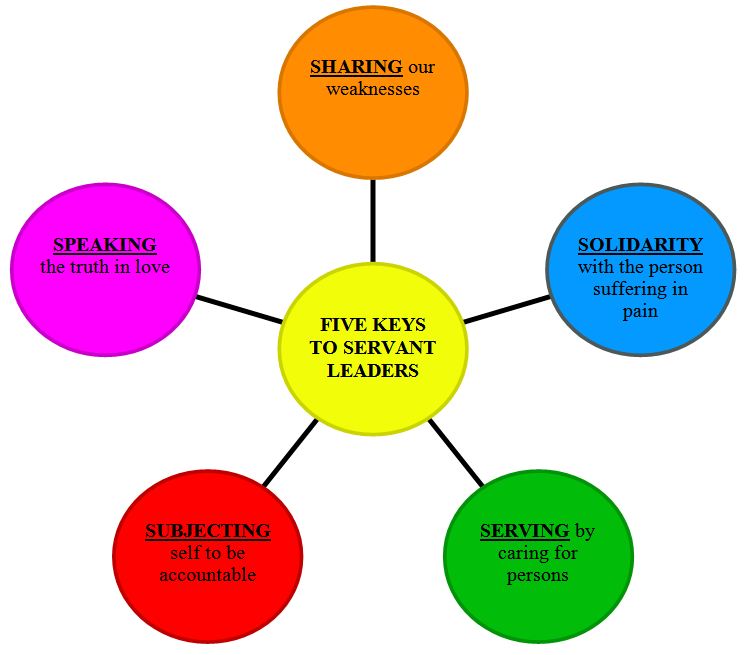
How to develop servant leaders? Use the Five Keys as a start.

How then do you develop Bible study leaders? In the light of 2 Timothy 3:10-11, we develop leaders beginning with ourselves. We may not take on an official role anytime yet. That does not mean we disqualify ourselves altogether. Why not consider living a life of a disciple first? Let me adapt Stacy Rinehart's five points about cultivating relationships by calling them keys on learning to be servant leaders.
  1. The Key of Sharing: "learn to risk sharing our weaknesses."
  2. The Key of Speaking: "say hard words in love to a brother."
  3. The Key of Subjecting Self: "to let someone really know our temptations and faults."
  4. The Key of Solidarity: "enter into someone else's pain."
  5. The Key of Serving: "care about the person and not the objective."

THOUGHT: "When we lament to God about the lack of servant leaders, and pray for more servant leaders, do not forget to look at the mirror, and ask God by saying: 'Here I am Lord, use me if you wish beginning with the five keys above.'"

sabbathwalk


Copyright by SabbathWalk. This devotional is sent to you free of charge. If you feel blessed or ministered to by SabbathWalk weekly devotionals, feel free to forward to friends, or to invite them to subscribe online at http://blog.sabbathwalk.org . You can also send me an email at cyap@sabbathwalk.org for comments or enquiries.

Wednesday, February 8, 2012

Is Worry a Sin?

TITLE: IS WORRY A SIN?
SCRIPTURE: Matthew 6:24-25
Written by: Conrade Yap
Date: 8 Feb 2012

"No one can serve two masters. Either he will hate the one and love the other, or he will be devoted to the one and despise the other. You cannot serve both God and Money. “Therefore I tell you, do not worry about your life, what you will eat or drink; or about your body, what you will wear. Is not life more important than food, and the body more important than clothes? " (Matt 6:24-25)

This prickly question can be controversial. It invites all kinds of theological interpretations. It has the potential to split groups. On the one hand, there are those who insist that any forms of worry is sin. Some argue from the Bible that because Jesus calls his disciples not to worry, and if the disciples still worry themselves out, it is a sin (Matthew 6:24-25). This is based on the contexts of serving either God or Mammon. If one serves God, one will learn to trust God, and not be given into worry. If one serves Mammon, the pressure will be to perform and to accumulate to the level of our own expectations. Worry comes as a result of the lack of trust. That is why they say worry is a sin.

On the other hand, others reason that there are legitimate worries. For example, a mother worries for her son when he fails to return home at his usual time. It can also be a frantic brother outside a hospital operating room worrying about his sister after a bad car accident. Is it a sin to worry like that?

A brother in my discipleship group shares that biblically, worry is sin. What is important is to be sensitive to the underlying concerns that surround such worries. Another brother shares wisely about worry being more of an 'attitude' rather than an act. He also advocates distinguishing 'concern' from 'worry.'

Wise words. I am inclined to agree with both of my learned brothers in Christ. There is a lot of wisdom in that. Yet, the questions remain. Is worry really a sin? How do we know when is it 'concern' and when is it 'worry?' The problem continues.

As I think about it, one of the most important ways to determine whether something is sin or not, is to know the Scriptures. Here are some of the verses dealing with sin.
  • "I have hidden your word in my heart that I might not sin against you." (Ps 119:11)
  • "Jesus replied, "I tell you the truth, everyone who sins is a slave to sin." (John 8:34)
  • "Everyone who sins breaks the law; in fact, sin is lawlessness." (1 John 3:4)
It is the Word of the Lord that is the reference. Disobedience to it is a mark of sin. In other words, sin is not what we human beings argue out to be. Sin is defined by God in the Bible.

A) Sin in the Bible

The Bible deals with many different aspects of sin. There is no one concept that is nicely packaged for us to take home. I will draw out some aspects of sin from the Old and the New Testament. In the Old Testament, sin is basically disobedience to God, as evidenced in the Garden of Eden, where Adam and Eve intentionally ate the forbidden fruit. Then we have the intentional worshiping of idols by Israel through the ages. The Law of Moses are written to instruct Israel about what is sin and what is not. The book of Amos contains multiple references to the different acts of sin.

In the New Testament, we see how the devil tries to tempt Jesus to sin in the wilderness. There is the sin of Judas Iscariot, and subsequently in the Pauline epistles, Paul warns the church against false and deceptive teachings that blur the lines of what sin is. The Greek word for sin essentially means 'miss the mark.'

Our working model for determining what is sin can be described this way. Sin is that deviation from the divine path. It uses anything to manipulate, distract, deceive, and disrupt any person's path toward God. The nature of sin itself is to miss the mark, and in the process, cause anybody to miss their mark, to miss out on their original calling. William P. Young, author of the bestselling book, The Shack, calls sin as follows:

"Sin is its own punishment, devouring you from the inside."

B) Worry as a Legitimate Human Emotion

Credit: CompleteSalesActionSystem
Let me try to reconstruct our understanding of worry in terms of a legitimate human emotion. Jesus in Matthew 6 realizes this as a typical human reaction to the problems and the struggles of this world. His remedy is simple: Do not look at the problem of what we ought to eat, what to drink, or what to wear. Instead, look at the certainties of God's providence.

Look at the birds of the air, and marvel at how God feeds them. Look at the flowers of the field, and take in the beauty of God's providence. A story was told of a man who happens to get everything that he wanted from the Lord.  He planted an olive sap. He asked God for rain, and God sent rain. He asked God for sunshine and God gave sunshine. He asked God to provide frost to firm up the leaves. God provided the frost. However, by the evening, the plant died.

In contrast, his friend planted a little tree about the same time. All he did was to pray to the Lord:

"Lord, whether, rain, sunshine, or frost, I do not want to bind your hands, but trust you to provide for this plant. Amen."

This friend's tree blossomed.

Through this story, it reminds us about who is actually trying to control life. Worry if it is an attempt to try to control events in this world, will lead us farther from God. Trusting God is a way that leads us away from sin.

C) Where There is Worry, Sin Abounds

It is quite hurtful to tell people that worry is a sin. Let me say that worry is a human emotion that we need to learn to manage with faith and with hope. Where there is worry, sin abounds. Sin will try to manipulate oneself into thinking one knows best, instead of God knows best.

Principle #1: Worry is not necessarily a sin, but where there is worry, sin is lurking very closeby.

It is one thing to worry and then forget all about it. It is yet another, to remain in a state of worry. It is in this state that sin wields its most powerful influence.

Principle #2: Worry becomes sin when it moves one away from God

When we try to take control, we are not trusting God. We are trusting anyone or anything other than God. Christians sometimes pay lip service to their faith. On the one hand they say they trust God. Yet, in their private moments, they worry themselves to death. Like the serpent that tricks Adam and Eve into eating the forbidden fruit. The evil thought that is planted in their heads causes them to question God's original command.  Their first result is to fear their own nakedness. This leads to the first murder where one brother killed the other out of envy. Cain's envy of Abel, leads him to take things into his own hands. Each act of sin moves people farther and farther from God.

If worry causes us to move away from God, that is sin.

Principle #3: Turn Worry Into a Journey Toward Contentment

For those who worry a lot, think of each worry in terms of an opportunity to trust God. Treat it as an invitation to start the journey toward a state of contentment. This is what Linda Dillow suggests. Learn to treat our anxieties and worries with a journey from control to contentment. Whenever things do not turn out her way, she worries a lot. Anxiety becomes depression soon after. It takes a friend to gently counsel her.
"Linda, you like control, and there are too many uncontrollables in your life."
Indeed. Worry is a sign that we are trying to control the uncontrollable. It is an attempt to wrest control from God. It is a stubborn retort that spits at God saying: "I know what is best."

When worry orientates itself away from God, it becomes sin. If worry is turned back toward God, and the person embarks on a journey from control to contentment, it becomes redemption.

D) Worry Little, Stop Quickly, Trust Fervently

It is ok to worry a little while. The important thing is not to remain in that condition. Worry is a result of our imperfect self, and it is not sensible to deny our basic expression of our emotions. It is a little bit like anger. We all do react angrily at matters of injustice. However, remaining in that state of anger for a prolonged period will breed harmful pride and destructive wrath. Righteous anger is acceptable. Jesus has been angry before at the merchants hawking goods outside the holy temple of prayer. It is normal for parents to worry about their children. The key is what happens AFTER the worry. Do we seek to grasp control for ourselves? Are we trying to claim we know best, more than God?

Each time we worry, take the 3-step process. First, let ourselves a little room to express our emotions either through sharing with a friend or loved one. Keep a leash on the time. Set a worry time if necessary.

Second, stop. When it is time to stop worrying, try to stop worrying. Pray. Meditate on the word.

Third, trust. Memorize key verses in the Bible that enables us to trust. Let me share three.


  • "Trust in the Lord with all your heart and lean not on your own understanding;in all your ways acknowledge him, and he will make your paths straight." (Proverbs 3:5-6)
  • "And he who searches our hearts knows the mind of the Spirit, because the Spirit intercedes for the saints in accordance with God’s will. And we know that in all things God works for the good of those who love him, who have been called according to his purpose. " (Romans 8:27-28)
  • "Do not be anxious about anything, but in everything, by prayer and petition, with thanksgiving, present your requests to God. And the peace of God, which transcends all understanding, will guard your hearts and your minds in Christ Jesus." (Philippians 2:6-7)

As for me, whether worry is literally a sin or not is not something we need to argue about. What is important is to love the person who are in the state of worry. Do not condemn or downplay that person's concerns. It is what that worry leads to that we need to pay careful attention to.

Worry is not necessarily always sin. It can lead to sin. What matters is not to remain in the state of worry. Worry loves to feed on more worry. If needed, worry but limit the worry. Then stop and turn our eyes to God and trust God.

THOUGHT: "The temptation of the age is to look good without being good." (Brennan Manning)

sabbathwalk


Copyright by SabbathWalk. This devotional is sent to you free of charge. If you feel blessed or ministered to by SabbathWalk weekly devotionals, feel free to forward to friends, or to invite them to subscribe online at http://blog.sabbathwalk.org . You can also send me an email at cyap@sabbathwalk.org for comments or enquiries.