Showing posts with label Trust. Show all posts

Thursday, March 5, 2015

In Memory of Chua How Chuang

TITLE: In Memory of Chua How Chuang
SCRIPTURE: 2 Corinthians 12:9
Written by: Dr Conrade Yap
Date: March 5th, 2015

"9But he said to me, “My grace is sufficient for you, for my power is made perfect in weakness.” Therefore I will boast all the more gladly about my weaknesses, so that Christ’s power may rest on me." (2 Cor 12:9)

Dr Chua How Chuang
Today is a day of much grief. Dr CHUA How Chuang went home to the Lord this morning. He is survived by Kaori and his three year old daughter Airi. He was a fellow Regent alum, who recently returned to Singapore from Hokkaido Japan as a missionary-teacher on behalf of OMF (Overseas Missionary Fellowship). After completing his PhD from Trinity, he was back in Vancouver for a visit. I met him for coffee and it was a really enriching time of sharing and caring. Though he was a scholar-theologian, and I was then a student at Regent, I could sense his gift in pastoral care emanating from his warm tone. We chatted like friends even though we had not seen each other for ages. The last time I saw him was way back in Varsity days. He was a VCF Staffworker then and spoke regularly at various Christian Fellowship events. I knew him then as someone who can speak and articulate biblical truths well. He was a well respected figure at Regent, and I remembered hearing about him being one of Dr J.I Packer's best Teaching Assistants. He was one of those students from Singapore who had held the Singapore flag up high in terms of research quality and academic excellence. How Chuang's thesis was based on the Puritan, Richard Baxter, entitled: "Christ, atonement, and evangelism in the theology of Richard Baxter." Not surprising as Dr Packer is an ardent reader of Anglicanism and Puritans.


Friday, June 6, 2014

Ps 46: Trusting God

TITLE: Ps 46: TRUSTING GOD
SCRIPTURE: Ps 46
Written by: Dr Conrade Yap
Date:  June 6th, 2014

"1God is our refuge and strength, an ever-present help in trouble. 2Therefore we will not fear, though the earth give way and the mountains fall into the heart of the sea, 3though its waters roar and foam and the mountains quake with their surging." (Ps 46:1-3)

If Christians claim to trust God, why then do many of them worry? You might be just making ends meet, but all of a sudden, you had a major car repair. There is no more money in your bank account. What do you do? Maybe, you have just gone for an interview and you are anxious about the result. You pray, and you praise God for what had been done. Yet, the worries linger on. Will you get the job? Maybe you are a student, and your exam is tomorrow but you have only covered 50% of the material. How confident are you that you can make the grade? These are some examples of how the cares of this world can easily balloon themselves to be so big that our theology of God suddenly becomes so small.

This question has often bugged me, and for this week, I want to spend some time on what it means to trust God, why we find it difficult to trust God, and what does it take to increase our walk of trust.

Friday, May 18, 2012

Developing Bible Study Leaders

TITLE: DEVELOPING BIBLE STUDY LEADERS
SCRIPTURE: 2 Timothy 3:10-11
Written by: Conrade Yap
Date: 18 May 2012

"You, however, know all about my teaching, my way of life, my purpose, faith, patience, love, endurance, persecutions, sufferings—what kinds of things happened to me in Antioch, Iconium and Lystra, the persecutions I endured. Yet the Lord rescued me from all of them." (2 Timothy 3:10-11)

[This is Part One of a Four-part series on Bible study.]

For the past four weeks, I have been writing on the small groups ministry, a vital part of any growing church. For the next four weeks, I will reflect on the place of the Word of God. In many Churches, Bible studies remain the core purpose of coming together. Call them care groups, contact groups, family groups, Alpha groups, Christian fellowship groups, or simply Bible study groups, all of them have one common purpose: To study God's Word. Part One focuses on developing the Bible Study Leader, beginning with ourselves. Before that, let me share a little of my life last week.

A) A New Phase

I graduated last week in absentia. Due to financial and logistical reasons, I had to skip the ceremony in Boston and South Hamilton. It would have been awesome to have my entire family celebrating the occasion with me wearing my doctoral regalia and receiving the award as a visual witness of the fruits of my years of work and hard labour. At least, my seminary has been kind enough to list my name on the website here. The journey had been long and tough.  Yet I feel strange. I feel awkard when people call me "Dr" to prefix my last name. I feel shy about it all, and also a little concerned whether my new title will distance me away from people I care for. At the same time, there is also that weirdness over expectations. Are people going to expect me to say profound words all the time? Am I going to be pushed out more into the limelight? How then do I remain grateful for the accomplishments and at the same time be humble about it all?

The end of one phase is but the beginning of another.

Someone asked me if I will be continuing with this Sabbath Walk weekly writings. Of course! Sabbath Walk has become my sabbathing journal. I write not because my dissertation topic happens to be on the Sabbath. I write because I love to write. I love to share my learning. I love to think aloud with words. That is my calling. That may very well be my second vocation. One thing is for sure, the Word of God will remain my key launchpad for any writing. I hope to encourage all of us to learn to handle the Word of God carefully, passionately, diligently, and reverently.

B) What is the Bible For?

What is the Bible for? Ask any Bible believing person and they will be quick to point out Scriptures that talk about the profitability of the Word of God, and how it can be beneficial for us.
 "All Scripture is God-breathed and is useful for teaching, rebuking, correcting and training in righteousness, so that the man of God may be thoroughly equipped for every good work." (2 Timothy 3:16-17)
Plain reading of the above suggests to us the purpose of the Bible. We can use it to teach, to rebuke, to correct, and to train in righteousness. In our culture of consumerism, there is a danger to consuming the Word and letting it end in our heads. Like a dam that prevents water from flowing farther downstream, when this happens, the Bible becomes merely a tool for self-knowledge and personal devotion. It makes the Bible appealing from a consumer standpoint, that while one can find his material needs from the world, one finds his spiritual needs from the Word. Put them together and one has a 'balanced' life. Right? No. Our goal in life is not about maintaining a balanced life as if we are controlled by a "yin-yang," "black-vs-white" or a "0 and 1" world. It is about glorifying God, regardless of personal balance or imbalance.

The trouble with such a mode is that we tend to miss out the context of 2 Timothy 3:16-17. We cannot read this verse in isolation from the person who had been inspired by the Holy Spirit to write it.  It is to be read together with knowing who is writing this. It comes from the pen of one who has been taught in the Word, who has lived in the Word, who has learned the Word in patience, kindness, goodness,  who have endured great trials and tribulations, and still is able to affirm the beauty and the power of the Word.

C) Profiting or Profiteering?

Is the Bible a tool for us? Is the Bible to be used the same way we use a screwdriver or a car? Is the Bible an engine to help us achieve our own objectives? Well. Sad to say, some people do. Some clever and classy people are experts at using the Bible to draw crowds, and then to promote themselves. Look at some of the prosperity gospel preachers, who come to the people declaring their love for God, and go away with loads of cash, voluntarily given by faithful believers who are taken in by the charisma or the good-feel effects of the charismatic preacher.  Others use the Bible as a pretext for self-gain. Like a leader of the Church who uses the Bible like a judge using his gavel, to push forth his ideas and his plans, using the name of God through the Bible. Cult leaders are experts at that. They take one or two verses in the Bible and then interpret it to the extreme.

No. God's Word are not for self-profiteering. It is for God-glorifying. Make sure our leaders are not gearing themselves out for personal profits to the detriment of the people and God.

D) Servant Leadership

The Word of God is seen to be alive in Paul, the teacher and discipler of Timothy. This means that the person that we are doing Bible study with must be exemplary in his life as a disciple. This is one of the most important marks of a Bible study leader. Is this leader a practitioner of the Word of God? Has this person gone through the ups and downs of life, and is still growing faithfully? Like Paul, is this leader able to endure and trust God to deliver? What do servant leaders look like? The table below from Stacy Rinehart gives us a stark contrast between power leaders and servant leaders.


As a Bible study leader myself, I need to be reminded again that my role is not to hang on to my role. My role is to develop leaders. My role is to be loyal to the people instead of insisting on people's loyalty. My role is to be faithful even though people in my group are not as regular, as punctual, or as faithful. My role is to magnify Christ above all. My role is to affirm God's kingdom, and not grow my own empire. My role is to be a servant and not insist on others being servants. My role is to make disciples of all nations, beginning with myself.
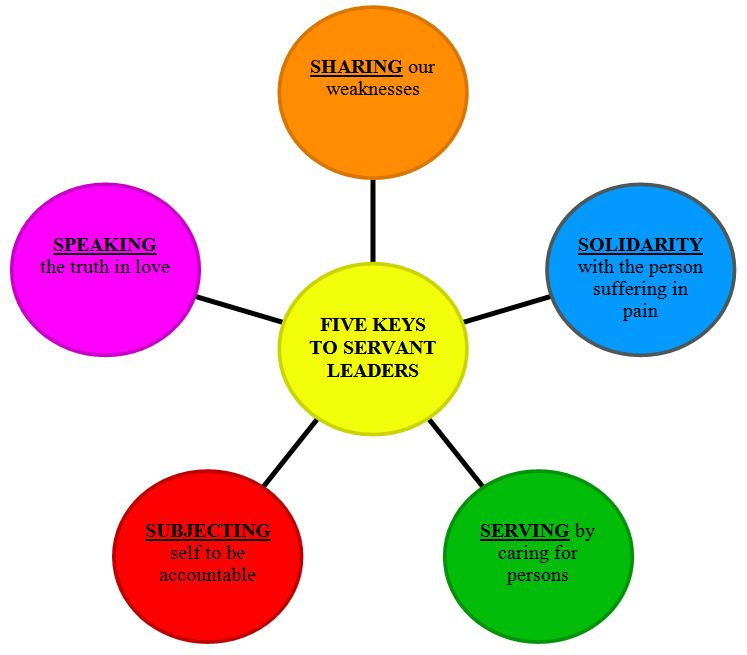
How to develop servant leaders? Use the Five Keys as a start.

How then do you develop Bible study leaders? In the light of 2 Timothy 3:10-11, we develop leaders beginning with ourselves. We may not take on an official role anytime yet. That does not mean we disqualify ourselves altogether. Why not consider living a life of a disciple first? Let me adapt Stacy Rinehart's five points about cultivating relationships by calling them keys on learning to be servant leaders.
  1. The Key of Sharing: "learn to risk sharing our weaknesses."
  2. The Key of Speaking: "say hard words in love to a brother."
  3. The Key of Subjecting Self: "to let someone really know our temptations and faults."
  4. The Key of Solidarity: "enter into someone else's pain."
  5. The Key of Serving: "care about the person and not the objective."

THOUGHT: "When we lament to God about the lack of servant leaders, and pray for more servant leaders, do not forget to look at the mirror, and ask God by saying: 'Here I am Lord, use me if you wish beginning with the five keys above.'"

sabbathwalk


Copyright by SabbathWalk. This devotional is sent to you free of charge. If you feel blessed or ministered to by SabbathWalk weekly devotionals, feel free to forward to friends, or to invite them to subscribe online at http://blog.sabbathwalk.org . You can also send me an email at cyap@sabbathwalk.org for comments or enquiries.

Friday, April 13, 2012

In Defense of Plan B

TITLE: In Defense of Plan B 
SCRIPTURE: Acts 16:6-8
Date: 13 Apr 2012
Written by: Conrade Yap

 “Paul and his companions traveled throughout the region of Phrygia and Galatia, having been kept by the Holy Spirit from preaching the word in the province of Asia. When they came to the border of Mysia, they tried to enter Bithynia, but the Spirit of Jesus would not allow them to. So they passed by Mysia and went down to Troas.” (Acts 16:6-8) 

Life is strange.

Sometimes I feel like we are easily stuck when we feel like we do not have all the right answers. More often than not, we like to have things laid out properly and done correctly before we really get that feeling of satisfaction. When things are rushed, we feel less than 100%. We are not as contented with the results, saying that things could have been better. When our Plan As fail to take effect, we kick in Plan B, often lamenting that “if only” we have Plan A, then life will be better. Much better. Pete Wilson writes about this effect on how we tend to believe that the grass is always greener on the other side. We say,

“Everyone else is getting married. Everyone else is having kids. Everyone else is successful. Everyone else is healthy. Everyone else is happy in their marriages - or content and productive in singleness.” (Pete Wilson, Plan B, Nashville, TN: Thomas-Nelson, 2009, 4) 
When our Plan As fail, we scramble our Plan Bs reluctantly. We work out our contingency plans not without dreaming how life is much ‘better’ if our As turn out according to plan. This week, I like to reflect on why we ought to see that very often, man’s Plan B may very well be God’s Plan A for us. 

A) When A Fails

People generally loves a good story. Fairy tales are best. It brings about the glimmer of hope that we can one day have a happily-ever-after ending. Single girls dream of being swept up by a handsome princely character, full of riches and charisma. Married men dream of a nice loving wife who cooks well, brings us children brilliantly, looks beautiful all the time, and provides excellent sex on bed. Young men envision careers that provides global travel with executive perks. Living in a society infatuated with all things success and happiness, everyone seeks after the same things: Becoming rich and successful. Even Christians are caught up in that mad rat race. They employ their best efforts. They utilize their connections. Some even use God. When times are good, they answer with shouts of “Hallelujah! Praise God!” When times are bad, they question God.

B) The Bithynia Denial

After traveling far and wide, Paul must have gotten used to preaching the gospel to different lands. After all, Acts recorded him making four missionary journeys in his outreach to the Gentiles. During his second missionary journey, made sometime between AD 50-52, Paul and his followers encountered a road block. After traveling westward through the lands of Galatia and Phrygia, they were attempting to bring the gospel to the lands west of Mysia. At that time, the Roman Empire has divided Phrygia into two separate regions: Asia and Galatia. It was in Asia that Paul encountered the impasse. This Roman province of Asia is not to be confused with our modern understanding of Asia. Around AD 25, the Romans have carved out an expanded area comprising of cities such as Mysia, Lydia, Caria, and parts of Phrygia.

So Paul and his companions, instead of heading up northward toward Bithynia, they headed west toward Troas. All because Paul had been prevented from entering Bithynia. Whether it is through visions, dreams, of physical barriers we do not know. What we do know is that Paul wanted to enter Bithynia (His Plan A) but instead entered Troas (Plan B). The text says that “the Spirit of Jesus would not allow them to” enter Bithynia. As a result, they skipped Mysia.

C) Paul’s Focus is on Christ

I am not sure how Paul felt at that time. Perhaps, he was disappointed that Bithynia was out of his reach. From the use of the Greek ‘perazo,’ it can be interpreted to indicate their best efforts to enter the land. This same verb can also be translated as ‘to attempt to go; or tempted to enter.’ It is enlightening to note that as far as the gospel is concerned, it is not the place of travel but the heart of obedience that matters. For Paul, if northward bound is not possible, head westward. It does not matter as long as the gospel is preached. This attitude has been recorded in Philippians 1:18:

“But what does it matter? The important thing is that in every way, whether from false motives or true, Christ is preached. And because of this I rejoice. Yes, and I will continue to rejoice,” (Philippians 1:18) 

I have heard of some friends of mine wanting to reach a particular people group for God. Along the way, their best intentions fell apart. Their dreams were not met. Their Plan A fails to materialize and they have to accept their Plan Bs, even Cs. I too have my fair share of Plan A not coming into play.

Back in 2004, I was eager to get theological training, and then return to my home church and hopefully teach in a local seminary. Naive and idealistic, my wife and I uprooted ourselves from the comforts of Singapore to go to Canada, thinking that after 3-4 years, we will all return and then serve happily ever after back home. Unfortunately, that Plan A seems more distant with each passing year. Our kids became more used to the school systems here. Lifestyles change. People changes. We change. Even the place that we used to call home has changed. The Singapore we know in 2004 is no longer the same as in 2012. My father passed away in 2010. Each time I returned home for a visit, people tend to be extremely busy with their own stuff. A friend of mine who has since decided to stay in Canada commented to me in a somewhat skeptical manner:
“Don’t bother returning to Singapore. People have no time for you anyway.” 
I hesitate to come to that conclusion. I know of many people who will spend time. I also understand why he said what he said. After all, I too have experienced my fair share of disappointments with regards to trying to meet up with ‘busy’ people in Singapore. You can plan ahead. You can even get all the people’s names and reminders in place. Yet, at the very last minute, things can change. People have their own priorities. Their Plan As are not necessarily yours, and your Plan As is not necessarily theirs.

Personally, we need to be open to one another. Emergencies can happen at any time. Our Plan As are often simply a plan waiting to be changed at last minute’s notice. Matt Chandler once said that there is a big difference between trust and understanding. Trust is what is needed when we lack the understanding. Likewise, when we fail to understand why our Plan As did not work, we need to trust God to help us work out our Plan Bs, Cs, or even Ds.

Who knows? Our Plan As need time to be baked in God’s perfect timing. In the meantime, He can choose to use us more effectively through Bs, Cs, Ds, Es, even Fs. As far as God’s will is concerned, it is not the plan per se. It is the heart that seeks to obey God regardless of what it is. Pete Wilson writes:

“God can take the pain and hurt you’ve experienced and use it to expand and mold your heart to reflect his heart. The question is, do you think you can sacrifice who you are today for who you could become?” (Pete Wilson, Plan B, 222) 

Bingo! Sacrificing something temporal in order to gain something eternal is priceless. Paul is able to obey God despite the Bithynian denial. He knows what is at stake. It is not his pride of being denied entry. Neither is it his frustration at why God is stopping him from sharing the gospel northward. As the song goes in the Jimmy and Carol Owens’s play called the Dreamer:

“When GOD Closes the door, HE opens a window,
so I can see HE's working it out the very best for me.
”

Trust God. Trust Him for all of your plans, not just your plan As or Bs. As far as God is concerned, He does not distinguish it according to A, B, C, D, or whatever. His goal is to love us so much that He gave Jesus for us. We are called to bring this love into our homes and beyond our local comforts of home.


THOUGHT:  "Disappointment to a noble soul is what cold water is to burning metal; it strengthens, tempers, intensifies, but never destroys it." (Eliza Tabor)

sabbathwalk


Copyright by SabbathWalk. This devotional is sent to you free of charge. If you feel blessed or ministered to by SabbathWalk weekly devotionals, feel free to forward to friends, or to invite them to subscribe online at http://blog.sabbathwalk.org . You can also send me an email at cyap@sabbathwalk.org for comments or enquiries.