Friday, May 25, 2012

Using the Bible?

TITLE: USING THE BIBLE?
SCRIPTURE: 2 Timothy 3:16-17
Written by: Conrade Yap
Date: 25 May 2012

[Part 2 of a series of 4 on the topic of Bible Studies.]

Last week, I touched on an important area of developing Bible Study leaders. In any group, it is important to have leaders. In a Bible Study group, the leader needs to be one who has and willing to cultivate a servant heart. This week, I will touch on the question of the use of the Bible.


A) Getting Something Out Of the Bible

Using the Bible for us, or to know God?
Sometimes, I hear well-meaning Christians confessing to me in private. "I cannot seem to get anything out of the Bible." Honestly, I shudder at such a statement. While I appreciate the frank comment, I feel sad that the statement tells more about the mindset of the person rather than the Bible per se.

In our consumerist culture, we use tools to fix our stuff, like a screwdriver to tighten screws, or a hammer to punch nails. We use a microwave oven when we need to heat food, and a car when we want to travel from place to place. We buy material things with money, and we exchange ideas with ideas. With such a dominant consumerist mindset, we unwittingly apply the same logic to the Bible, and especially Bible study.

So diverse are the needs of people, and the great belief that the Bible can be used to meet all of these needs, that Bible publishers have turned the Holy Bible into a "Chicken Soup" series like enterprise. From busy mums to retirees, from little children to working adults, from sportspersons to military people, there is a Bible for every kind of need. The premise is simple. The Bible is God's Word for us. We are needful people. The Bible meets needs. Thus, use the Bible to meet self-needs.

KEY POINT: The statement, "I am not getting anything out of the Bible" reflects more of a pathetic case of self-importance. Read the Word. Pray, and ask for help, trusting in God's time, we will understand what the Word means to us. That is the purpose of Bible study: Meditate, keep the Word, and wait.

Friday, May 18, 2012

Developing Bible Study Leaders

TITLE: DEVELOPING BIBLE STUDY LEADERS
SCRIPTURE: 2 Timothy 3:10-11
Written by: Conrade Yap
Date: 18 May 2012

"You, however, know all about my teaching, my way of life, my purpose, faith, patience, love, endurance, persecutions, sufferings—what kinds of things happened to me in Antioch, Iconium and Lystra, the persecutions I endured. Yet the Lord rescued me from all of them." (2 Timothy 3:10-11)

[This is Part One of a Four-part series on Bible study.]

For the past four weeks, I have been writing on the small groups ministry, a vital part of any growing church. For the next four weeks, I will reflect on the place of the Word of God. In many Churches, Bible studies remain the core purpose of coming together. Call them care groups, contact groups, family groups, Alpha groups, Christian fellowship groups, or simply Bible study groups, all of them have one common purpose: To study God's Word. Part One focuses on developing the Bible Study Leader, beginning with ourselves. Before that, let me share a little of my life last week.

A) A New Phase

I graduated last week in absentia. Due to financial and logistical reasons, I had to skip the ceremony in Boston and South Hamilton. It would have been awesome to have my entire family celebrating the occasion with me wearing my doctoral regalia and receiving the award as a visual witness of the fruits of my years of work and hard labour. At least, my seminary has been kind enough to list my name on the website here. The journey had been long and tough.  Yet I feel strange. I feel awkard when people call me "Dr" to prefix my last name. I feel shy about it all, and also a little concerned whether my new title will distance me away from people I care for. At the same time, there is also that weirdness over expectations. Are people going to expect me to say profound words all the time? Am I going to be pushed out more into the limelight? How then do I remain grateful for the accomplishments and at the same time be humble about it all?

The end of one phase is but the beginning of another.

Someone asked me if I will be continuing with this Sabbath Walk weekly writings. Of course! Sabbath Walk has become my sabbathing journal. I write not because my dissertation topic happens to be on the Sabbath. I write because I love to write. I love to share my learning. I love to think aloud with words. That is my calling. That may very well be my second vocation. One thing is for sure, the Word of God will remain my key launchpad for any writing. I hope to encourage all of us to learn to handle the Word of God carefully, passionately, diligently, and reverently.

B) What is the Bible For?

What is the Bible for? Ask any Bible believing person and they will be quick to point out Scriptures that talk about the profitability of the Word of God, and how it can be beneficial for us.
 "All Scripture is God-breathed and is useful for teaching, rebuking, correcting and training in righteousness, so that the man of God may be thoroughly equipped for every good work." (2 Timothy 3:16-17)
Plain reading of the above suggests to us the purpose of the Bible. We can use it to teach, to rebuke, to correct, and to train in righteousness. In our culture of consumerism, there is a danger to consuming the Word and letting it end in our heads. Like a dam that prevents water from flowing farther downstream, when this happens, the Bible becomes merely a tool for self-knowledge and personal devotion. It makes the Bible appealing from a consumer standpoint, that while one can find his material needs from the world, one finds his spiritual needs from the Word. Put them together and one has a 'balanced' life. Right? No. Our goal in life is not about maintaining a balanced life as if we are controlled by a "yin-yang," "black-vs-white" or a "0 and 1" world. It is about glorifying God, regardless of personal balance or imbalance.

The trouble with such a mode is that we tend to miss out the context of 2 Timothy 3:16-17. We cannot read this verse in isolation from the person who had been inspired by the Holy Spirit to write it.  It is to be read together with knowing who is writing this. It comes from the pen of one who has been taught in the Word, who has lived in the Word, who has learned the Word in patience, kindness, goodness,  who have endured great trials and tribulations, and still is able to affirm the beauty and the power of the Word.

C) Profiting or Profiteering?

Is the Bible a tool for us? Is the Bible to be used the same way we use a screwdriver or a car? Is the Bible an engine to help us achieve our own objectives? Well. Sad to say, some people do. Some clever and classy people are experts at using the Bible to draw crowds, and then to promote themselves. Look at some of the prosperity gospel preachers, who come to the people declaring their love for God, and go away with loads of cash, voluntarily given by faithful believers who are taken in by the charisma or the good-feel effects of the charismatic preacher.  Others use the Bible as a pretext for self-gain. Like a leader of the Church who uses the Bible like a judge using his gavel, to push forth his ideas and his plans, using the name of God through the Bible. Cult leaders are experts at that. They take one or two verses in the Bible and then interpret it to the extreme.

No. God's Word are not for self-profiteering. It is for God-glorifying. Make sure our leaders are not gearing themselves out for personal profits to the detriment of the people and God.

D) Servant Leadership

The Word of God is seen to be alive in Paul, the teacher and discipler of Timothy. This means that the person that we are doing Bible study with must be exemplary in his life as a disciple. This is one of the most important marks of a Bible study leader. Is this leader a practitioner of the Word of God? Has this person gone through the ups and downs of life, and is still growing faithfully? Like Paul, is this leader able to endure and trust God to deliver? What do servant leaders look like? The table below from Stacy Rinehart gives us a stark contrast between power leaders and servant leaders.


As a Bible study leader myself, I need to be reminded again that my role is not to hang on to my role. My role is to develop leaders. My role is to be loyal to the people instead of insisting on people's loyalty. My role is to be faithful even though people in my group are not as regular, as punctual, or as faithful. My role is to magnify Christ above all. My role is to affirm God's kingdom, and not grow my own empire. My role is to be a servant and not insist on others being servants. My role is to make disciples of all nations, beginning with myself.
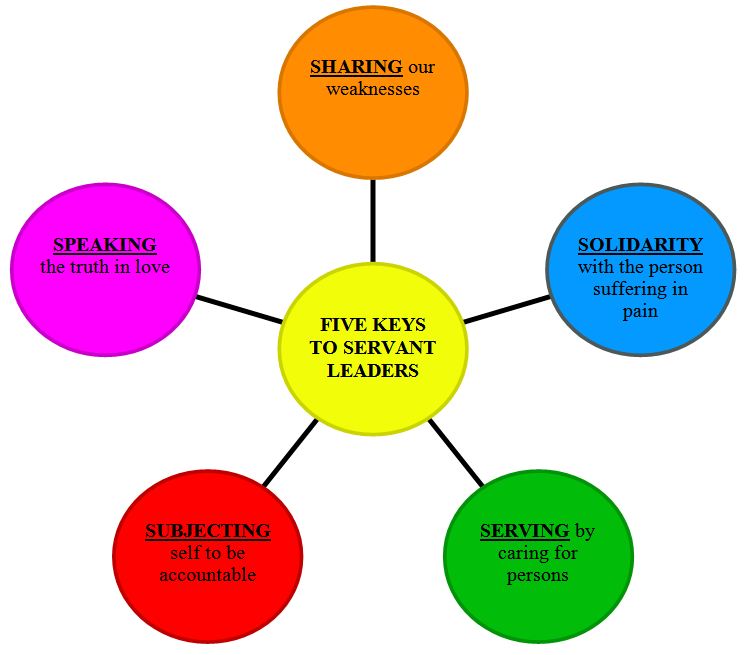
How to develop servant leaders? Use the Five Keys as a start.

How then do you develop Bible study leaders? In the light of 2 Timothy 3:10-11, we develop leaders beginning with ourselves. We may not take on an official role anytime yet. That does not mean we disqualify ourselves altogether. Why not consider living a life of a disciple first? Let me adapt Stacy Rinehart's five points about cultivating relationships by calling them keys on learning to be servant leaders.
  1. The Key of Sharing: "learn to risk sharing our weaknesses."
  2. The Key of Speaking: "say hard words in love to a brother."
  3. The Key of Subjecting Self: "to let someone really know our temptations and faults."
  4. The Key of Solidarity: "enter into someone else's pain."
  5. The Key of Serving: "care about the person and not the objective."

THOUGHT: "When we lament to God about the lack of servant leaders, and pray for more servant leaders, do not forget to look at the mirror, and ask God by saying: 'Here I am Lord, use me if you wish beginning with the five keys above.'"

sabbathwalk


Copyright by SabbathWalk. This devotional is sent to you free of charge. If you feel blessed or ministered to by SabbathWalk weekly devotionals, feel free to forward to friends, or to invite them to subscribe online at http://blog.sabbathwalk.org . You can also send me an email at cyap@sabbathwalk.org for comments or enquiries.

Friday, May 11, 2012

Meeting One Another's Needs?

TITLE: MEETING ONE ANOTHER'S NEEDS?
SCRIPTURE: Acts 4:34
Written by: Conrade Yap
Date: 12 May 2012

"There were no needy persons among them. For from time to time those who owned lands or houses sold them, brought the money from the sales." (Acts 4:34)

This is the concluding part of a 4-part series on Small Groups Ministry in the Church. The key point in this article is that meeting needs of members is not the primary responsibility of small groups. Meeting needs is very much secondary.

A) No Needy Among Them

Tucked in a corner of the book of Acts is this amazing little verse that says, "There were no needy persons among them." No needy people? You've got to be kidding!  In every Church I go to, every community I get involved with, the needs often exceed the supply. Some complain that the pastor hardly visits or calls on them. Others say that they feel neglected even on Sundays. Still, there are those who comment that the pastoral care in their community is grossly lacking. When they need some attention, the pastor is either unavailable or too busy.

My friends in the pastoral ministry regularly tell me that they needed a break, or a time away just to recuperate from an exhausting period of meeting the needs of their members and congregations. It is interesting that the very people who try to help parishioners rest in the Lord, themselves are often the recipients of their very own advice: The need to rest in God alone.

Meeting needs involve sharing and caring
B) Is It the Colony Instinct?

The book of Acts presents us with an interesting observation. Mind you, the early disciples in Acts are not rich people materially. They are often poor, and come from the lower ranks in society. Without a large personal bank account, or an enormous inheritance, they give whatever they have. If necessary, they sell their possessions to give to all who have need. Like worker bees individually collecting nectar from flowers, they return to the common hive to contribute to the food collection for the entire bee community. If anyone of us dares to look down on the collected nectar of each tiny bee, just take a look at the honeycomb.

I always believe that as a group, we meet one another's needs at different points of time. Not everyone of us is up or down all at the same time. There will always be some who is bubbly at some time. Others may be downcast at other times. In a group, there is a good chance that there will always be a mixture of the needy and the helper. Sometimes, we are needy. Other times we are able to help others. Together, we develop a caring and sharing community that ministers to one another at different points of time.

C) Weakness in the Small Group Model

In the book of Acts, meeting needs is not the primary responsibility of the pastor or leaders of the church. The responsibility lies in the entire community who essentially "were one in heart and mind." Dr Robert W. Kellemen points out a shrewd observation on the weakness of the small group model. While many churches use small groups to provide a care-and-share method, most people in the church (up to 50%) are not in small groups. Moreover, while the small group model works better than a mere dependence on the pastoral team, the small group system fizzles out over time due to fatigue or lack of training of small group leaders. He makes this observation.

"Unfortunately, many churches provide little equipping  in small-group leadership - especially  in the personal ministry of the Word of speaking the truth in love." (Robert Kellemen, Equipping Counselors for Your Church, Phillipsburg, NJ: P&R Publishing, 2011, 41)

Kellemen proposes something better than mere care-and-share small group networks. He recommends "equipping." This is the key role in any leadership.

D) Equipping is the Key for Growing Small Groups

How did the early Church in Acts learn to meet each other's needs so well? Cursory reading may well suggest that the people basically sell all their property and distribute all to anyone in need. That is quite correct. After all, the act of sharing and giving is an act of trust. When one gives away something, one trusts God to provide in other ways.

However, I see something more crucial in the act of meeting one another's needs. Before Acts 4:34, there is Acts 4:31.

"After they prayed, the place where there were meeting was shaken. And they were all filled with the Holy Spirit and spoke the word of God boldly." (Acts 4:31)

Bingo! Meeting another's needs is not simply a physical or emotional exercise. It originates from something very spiritual. More specifically, it originates from the Word of God, inspired by the work of the Holy Spirit. It is from the inspiration of the Spirit and spurred the early Church to preach and practice the Word of God boldly. In other words, meeting needs is not the primary role of any group. Meeting needs is a subset of something bigger: Bold proclamation of the Word.

This is where the equipping of the saints is highly crucial. Remember Jesus' reply to the tempter in Matthew 4:4? Responding to the temptation of turning stones into bread, Jesus answered, “It is written: ‘Man does not live on bread alone, but on every word that comes from the mouth of God.’”

E) The True Source of Meeting Needs

It is easy to be distracted by the needs around us (bread) that we forget the true source of help (Word). It is also tempting to try to touch every single life we meet with our modern church models, even small groups, substituting our primary responsibility (to proclaim God) with our secondary duties (meeting needs). Worse, while trying to meet needs as a primary focus, we end up trying to play the role of God. Can a blind lead the blind? Can the weary bring true rest to the needy? Are leaders really super-counselors that they have less needs than others?

No! If meeting needs is the key focus of any leader in the church, it is only a matter of time before that leader burns out. The key focus of a leader is to equip. There is no substitution for the Word of God. Kellemen adds,

"Our trainees need to feed on God's Word. They need to develop the conviction that the deepest questions of the human soul are God-questions, and that we find our deepest answers in God's Word." (Kellemen, Equipping Counselors, 207)

Let me repeat. Meeting the needs of members are secondary purposes of any small group.  That is the responsibility of the movement of the Holy Spirit. The primary responsibility is the Word of God. Our role is to equip one another in the Word, to disciple one another to become more like Christ. In prayer, in coming together, in sharing, we must always have the Word of God in our midst. Otherwise, we can easily become another statistic in the unending numbers of needy ones. As we fix our eyes on God, through the Word of God, our awareness of our neediness becomes strangely dim, in the light of God's glory and grace.


THOUGHT: Plant a word in the mind, and you will reap an act. Plant the act and you will reap a habit. Plant a habit and you will reap a character. Plant a character and you will reap a nature. Plant a nature and you will reap a destiny. (unknown)


sabbathwalk


Copyright by SabbathWalk. This devotional is sent to you free of charge. If you feel blessed or ministered to by SabbathWalk weekly devotionals, feel free to forward to friends, or to invite them to subscribe online at http://blog.sabbathwalk.org . You can also send me an email at cyap@sabbathwalk.org for comments or enquiries.

Wednesday, May 2, 2012

Four Kinds of Small Group Participants

TITLE: FOUR KINDS OF SMALL GROUP PARTICIPANTS
SCRIPTURE: Ephesians 5:1
Written by: Conrade Yap
Date: 3 Apr 2012

"Be imitators of God, therefore, as dearly loved children and live a life of love, just as Christ loved us and gave himself up for us as a fragrant offering and sacrifice to God." (Ephesians 5:1-2)
[This is Part 3 of a series on Small Group Ministry]

This week, an opinion poll suggests that "Canadians want everything for nothing." The statement is based on half the number of people surveyed who will vote against any politician who hikes taxes. While they are quick to demand for all things, from social welfare to personal benefits, they are extremely reticent, even vocal against paying for them. Paul Kershaw, a professor at the University of British Columbia observes that there are more people with an "anti-tax" sentiment who "want something for nothing." (Source: News1130.com, May 2nd, 2012)

Scary. If the report is true, that we are seeing a new generation of people who want everything, but unwilling to give anything, we are in trouble. In economic theory, the:re is what is called a "multiplier effect," where a stimulus leads to a knock-on effect that will generate a life of its own. Governments often provide the initial investment. A simple example goes like this. The Government issues a billion dollar contract to a big corporation to build a highway. This big corporation goes on to engage hundreds of other subcontractors and workers, who in turn benefit other entities like restaurants, hotels, transportation, logistics, school, and other miscellaneous sectors. In other words, one giant stimulus gets multiplied many fold. While there are other practical limits to such a theory, the idea is basically this: Giving stimulates economic activity or giving, taking, and sharing.

What if in our small groups in church, we see more of such people who give nothing but expect everything? There will be no multiplier effect. Worse, it becomes a shrinking effect when everybody takes and nobody gives. Continuing our series on small groups, this week, I like to suggest that there are at least four kinds of people in any small group environment. On the healthy end of the spectrum is a group called "healthy lambs" and "skinny goats" that nourish the whole community. On the unhealthy end, the appearance of "lamp-poles" and "leeches" suck away the life of the group. My main point in this article is that we should all strive to become the healthy kind, the healthy lamb. Let me first begin with the worst kind of participant, what I call the LEECH. Eeek!

Friday, April 27, 2012

SMALL GROUP LEADERSHIP

TITLE: SMALL GROUP LEADERSHIP
SCRIPTURE: Acts 2:13-14
Written by: Conrade Yap
Date: 27 Apr 2012

"Some however, made fun of them and said, 'They have too much wine.' Then Peter stood up with the Eleven, raised his voice and addressed the crowd." (Acts 2:14)

This is Part 2 of a series of 4 articles dedicated to small groups ministry. For the next three weeks, I will write about small groups with regards to leadership, to meeting inner membership needs, and to reaching out and outreach as a group.

A) Leaders are So Hard to Find

I have been involved with small groups ministry for a long time. Since my Inter-Varsity days, where I first came to the faith, I have been active as a participant, as an organizer, as a leader, and increasingly as a trainer and equipper. Everywhere I go, there is a recurring need: Leaders.

Leaders are so hard to find. Good leaders are even more difficult to get. This is why one of the most important activities in the Church is training and development. Back in my undergraduate days when I first became a Christian, I was filled with enthusiasm to be with fellow believers, to learn from my seniors, and to grow in Christ. I read. I pray. I memorize Scripture. When it comes to the Annual Leadership Conference organized by my fellowship, I would just say to myself that those are for the more experienced, the more capable, and the more mature people. I had no sense of calling. I had no idea what leadership actually means or requires. I preferred to simply grow my own faith, and be content with my small circle of brothers and sisters in Christ. Living together in the hostel can be fun. People would come by my room each day, thanks to my proximity to my neighbours who were extremely active in the Christian Fellowship. They had many more years of experience as a Christian than me. I was barely two years old in Christ. One evening, the chairman of the Fellowship came by. I was visiting my neighbours. He was confirming the attendance list for the annual leadership training event with my esteemed neighbours. I happened to be visiting and chatting away with them. The chairman said that he had one last spot on the Christian leadership training course. Whether it is by coincidence or by divine calling, he saw me and offered me the opportunity to take that last spot.

I was bowled over. Me? I'm such a young believer.

My neighbours egged me on. The chairman looked at me with an inviting eye. I was floored. Resistance then is futile. Thus began my introduction to leadership. Simply put, I was there at the right time, at the right place, and at the right moment. I did not know why I accepted the opportunity then. What I do know is that I am glad I accepted the invitation. It opened my eyes to the new world of being a leader for Christ. It encouraged me to grow in ways that I would never have dreamed possible.

B) Sweet Spot of Leadership

Leadership Discernment: G.O.A.L
One of the ways in which discernment needs to do is to locate what Max Lucado calls the "sweet spot." I like to call it the G.O.A.L. Comprising three concentric circles, spiritual discernment is to find the spot where three things intersect: Gloryfying God; Opportunity to Serve, and Availability of our Strengths, toward Leading for God. I call it the way to discern our calling.

Three questions are to be asked in discerning God's call for leadership.

  1. G: How does it glorify God?
  2. O: What are the opportunities and needs in my community?
  3. A: What are my available strengths?

The central point of intersection is a great spot for us to discern our calling to leadership.

B) G = Glorifying God

When the early Church experienced ridicule from people who said that they were drunk from wine, Peter stood up to lead the disciples. Instead of cowing away in fear like what he did to Jesus when he denied Christ thrice, Peter became a fearless witness for God. He seeks to glorify God with his leadership.

In small group environments, sometimes it is easy to get caught up in trying to make small groups an end in themselves. Call it a "Holy Huddle" or an exclusive "Holy Club." These groups exist only for themselves. I have known of groups which continue to remain in the similar size for decades. They are mainly content in serving one another. Leaders need to learn to see beyond the obvious membership needs. As a Shepherd, he/she needs to keep in mind how the group glorifies God. One of the things I regularly do in my group is to worship as a group. Playing musical instruments is not a requirement for leadership though it can surely enrich the worship experience. One reason why I like to encourage singing as a group is because it unites all of us to sing as one body. In singing, we remind one another the reason we gather. Songs like "As we gather" or "Bind us Together" remind us of our common bond in Christ and the reason we gather. The key is to let the worship guide our thoughts and to allow the Spirit of God to set the mood for the meeting. If there is no one who can play the music, use an MP3 player, or a Youtube video. Sing Acapella. Read Scripture. Leaders must be worshipers themselves. Worshipers will worship regardless of music, instruments or available facilities. The moment the prospective leader shuns away from worship, he has disqualified himself from leadership.

C) O=Opportunities

The Early Church waited for the Holy Spirit to come, and when the Spirit fills their hearts, they are empowered to serve and the share the gospel. Acts 2 shows us that the people were gathered together as one body when the Spirit arrives. Being Church is essentially coming together as a people of God in the Name of Christ. When people come together, they open themselves to learn to recognize needs within the group as well as outside the group.

The next question to ask is about the opportunities and needs around us. It is tragic to see groups disperse when the leader fails to turn up for the meeting. When I lead groups, I make attendance a priority. The one person expected to be present at ALL meetings is the leader. As I look back at my years in leading small groups, I notice one thing: No one else beats my attendance record. Another thing is, I find coming to small group gatherings a joy rather than a chore.

The needs of any group are many. Probe deeper and one will easily find all kinds of challenges. They can range from issues with spouses to discipline matters with children. While people can sometimes choose to come on the basis of how interesting the topic of study is, when the relationships are there, people will come. In other words, for those without good relationships with the other group members, often come to the meetings on the basis of how interesting the study is or how convenient the meeting times and locations are. Those with good relationships will come regardless of the logistics or the study.

Leaders are to maintain a conscious balance for both content of the meetings as well as the relationships among the group. The most important opportunity available for leaders is prayer. Leaders must be prayerful people for their group members. If a prospective leader shuns from prayer, he has disqualified himself from leading small groups.

D) A=Availability

Peter has a gift of leadership. As the spokesman of the group, he stood up with the Eleven to address the  crowd. He made himself available to be used by God, on behalf of the group, to share with the hearers outside the group. Peter could have said that he is busy trying to unite his small group of new believers. He could have spent time to analyze what had happened when the Spirit fell on them. He could have avoided the ridicule of the people by just closing the door in the upper room. Instead, he made himself available to speak for the group, and for God.

In our modern world, "busy" is our common name. It is a cultural symbol of importance. It becomes a convenient excuse for anything we try to avoid. "Busy" is a catch-all reason not to go for any small group meetings. When one is unwilling, any reason is good enough, including busyness. If a prospective leader is not willing to make sacrifices, to make him or herself available for the greater cause, he/she has disqualified him/herself from leadership.

E) Leaders are Called

Leading small groups is not necessarily difficult. Taking up the mantle of leadership can be quite an easy feat. The challenge is to grow in leadership. Entering is easy. Sustaining is hard. Good leaders are growing leaders themselves. They need to. I take encouragement from the life of Peter. Having been a disciple of Jesus for three years, his number of years as a believer is perhaps about 4 years by Acts 2. Some Churches tend to choose only from people who have more than 10 years as a believer. No. I know of some who have been Christians for many years but remain spiritual babies. On the other hand, there are young Christians who are giants in faith.

My former professor at Regent College has this to say about leadership and calling.

"Inherent in God's call is something fierce and unmanageable. He summons, but he will not be summoned. He does the calling; we do the answering. . . . . . At times we try to tame the call by equating a staff position in a church or religious organization with the call itself. But the call always transcends the things we do to earn money, even if those things are done in the church. Our vocation in Christ is one thing; our occupations, quite another." (Darrell W. Johnson, "The Call to Ministry," in Leadership Handbook of Management and Administration, Baker Books, 2007, 43)
I thought about my early years as a Christian. In my heart, I asked about how best to glorify God (G). The opportunity to be trained as a leader was offered to me: (O). Inside my heart I was nervous but keen to take the step of faith. I made myself available (A). That began my growth as a leader.

What about you? Is God calling you to avail yourselves to be a leader? Are you willing to step up to serve? Are you willing to carve out time to pray for your group members? Are you prepared to give up personal comfort for the sake of community benefit? If the answer to any of these is yes, follow the Spirit's prompting.


THOUGHT: "We often say we have no priest, but that is not so. The fact is that we are all priests, or potential priests. In the same way, we may think we have no leaders, but that is not so either. We are all leaders, or potential leaders. Just as we are all required to be prepared to minister through the spoken word, we are all required to be prepared to receive a leading, or a prompting which may call us and others in directions we had not dreamt of." (Margaret Heathfield, a Quaker)

sabbathwalk


Copyright by SabbathWalk. This devotional is sent to you free of charge. If you feel blessed or ministered to by SabbathWalk weekly devotionals, feel free to forward to friends, or to invite them to subscribe online at http://blog.sabbathwalk.org . You can also send me an email at cyap@sabbathwalk.org for comments or enquiries.
Friday, April 20, 2012

On Small Groups

TITLE: ON SMALL GROUPS
SCRIPTURE: Acts 2:42-47
Written by: Conrade Yap
Date: 20 Apr 2012

"They devoted themselves to the apostles’ teaching and to the fellowship, to the breaking of bread and to prayer. Everyone was filled with awe, and many wonders and miraculous signs were done by the apostles. All the believers were together and had everything in common. Selling their possessions and goods, they gave to anyone as he had need. Every day they continued to meet together in the temple courts. They broke bread in their homes and ate together with glad and sincere hearts, praising God and enjoying the favor of all the people. And the Lord added to their number daily those who were being saved."(Acts 2:42-47)

I will be graduating next month from my doctoral program. That means, after May 11th, you can officially call me (Dr), though I will feel weird about it all. I want to pay tribute to my small group in Singapore. Many of them have been supporting me in different ways for the many years since I left for Vancouver. Thus, for the next four weeks, beginning with this article, I will be writing on small group matters. This week, I will be reflecting on small groups as a necessary part of any Church. Growing Churches will have vibrant small groups. Growing groups have people who are convicted by the Holy Spirit about one's sin, counseled by one another, and live in community that shares not just material needs, but spiritual needs.

A) Growing Churches (Acts Style vs Modern Style)

I have read Acts 2 umpteen times, never bored, always amazed. Amazed at how united the members of the early Church are. Amazed at how diligent they meet on a daily basis. Amazed at the same things that they do and yet they do not seem to be bored by the routine.  Most of all, I am amazed that the Lord added to their numbers on a daily basis. In a context of a Western Church that seems to be shrinking year after year, this passage of Scripture appears out of this world! The Church in Acts shares everything they have. The modern Church takes when it is possible. The Acts Church comes together daily enthusiastically. The modern Church gathers on a weekly basis, depending on one's work schedule.The Acts Church gave fully of what they have. The modern Church gives a little of what they have. The Acts Church enjoys the favor of all the people. Many in the modern Church expect favor from people.

In a nutshell, the modern Church is a far cry from the early Church. I confess I may have been a little harsh on the modern Church. My point is that I am more amazed at how the Church in Acts behave. I am simply giving credit where credit is due. The Acts Church is amazing! It does something that modern Church seminars, inspirational talks, or leadership conferences cannot replicate. Growth. We have seen how the world's largest Church has grown beyond a million members. South Korea's David Cho Yonggi's Church has been growing tremendously. We have also seen the great success stories of Willow Creek Community Church in Chicago, as well as Rick Warren's Saddleback Church. There are also stories of the unofficial church in China, North Korea, and elsewhere in Africa that are growing by leaps and bounds.  A sizable amount of growth comes from the prosperity gospel camp.

B) A Growing Church Has Vibrant Small Groups

Go to most growing churches and you can easily hear leaders talking up the impact of small groups and how people's lives have been changed. Most churches have them. Traditional churches need them. Megachurches thrive on them. One of the biggest impacts have come about through the popular concept of 'cell groups.'

Groups are essential to any Church. It is essential for community building. A healthy Church is not one that has a big building packed every Sunday. A healthy Church is one that has every member in a small group. In other words, a healthy Church is not an efficiently run organization, but a living organism. An organization can strategize, plan, and implement programs to attract people. An organism will be attractive in itself. After all, if a person is cared for, and is able to care for others, everything else is secondary. That includes programs, type of study materials, or the logistics of meeting times and places. If a person has a reason to come, he/she will find every means to make it to the meeting. If the person does not want to come, any excuse is possible.

C) A Program Is Only An Introduction

I once interviewed a pastor at a large Church about his Church strategy for growth. "Programs!" he said. His reasoning was that the programs are needed to meet the different needs of the people. Thus, there are programs for different ethnic groups, various age groups, and all kinds of interest groups. The basic conviction is that, with the right program mix, the people will keep coming, and keep bringing friends. I am not too sure if that works. I know of several people from that same church. Apparently, they are not very involved in the Church at all. "Attend Church service only" is the regular answer. The pastors do not know them. They do not know others. Others do not even know they exist. My problem with this approach is that programs may draw people in, but they do not necessarily build relationships. We build relationships with people meeting people where they are, not programs catering to people's tastes.

My point is, programs come and go. People live and love. Programs only lead us to the meeting place, but the rest is up to the people. Programs are temporal. People are not. If that is the case, why focus on programs when we ought to focus on people?

Now, let me be clear. I am not against programs. I simply want to maintain that programs are only introductions or invitations. The growing and the relating is up to God using us, and us obeying the Spirit's leading.

D) Small Groups are Necessary

John Wesley has often been credited with the invention of small groups. Douglas Hunt calls Wesley the "pioneer of small-group evangelism." Tim Stafford acknowledges the small group as one of Wesley's "most enduring legacies." It has also been widely recorded that John Wesley's famous "Holy Club" marks one of the earliest versions of Wesleyan style small groups. Here is one tip that Wesley has given the Christian world. D Michael Henderson has even called John Wesley's Class Meetings as the "Model for Making Disciples." John Wesley writes about the beginning of a small group.

"In the latter end of the year 1739, eight or ten persons came to me in London, who appeared to be deeply convinced of sin, and earnestly groaning for redemption. They desired (as did two or three more the next day) that I would spend some time with them in prayer, and advise them how to flee from the wrath to come; which they say continually hanging over their heads; that we might have more time for this great work, I appointed a day when they might all come together; which from thenceforward, they did every week, namely, on Thursday, in the evening. To these, and as many more as desired to join with them (for their number increased daily) I gave those advices, from time to time, which I judged most needful for them; and we always concluded our meeting with prayer suited to their several necessities." (John Wesley, in his Preface to the Rules of the Societies)

Like the Acts Church, I am amazed at John Wesley's strict no-holds-barred purpose of conviction, counsel, and communion. Firstly, there is a conviction to tackle sin head on. Secondly, there is counsel via opportunities to pray and come together to meet on a regular basis. While it is a little different from the Acts Church which meets regularly, Wesley's model follows the rules of consistency (every week) rather than a literal copy of Acts (every day). Thirdly, there is a communion element, whether people's needs are addressed via prayer.

Be amazed by the quantity of people being added in the Acts Church. Be amazed by the desire of people to meet to confess sins and grow in Christ during Wesley's times. Can you be amazed by opportunities in your Church to grow small groups? You do not need many. Just begin with two or three persons and launch a small group. Do all the sowing that you can. Do all the watering that you can. Do all the care and cultivation that you can. Then sit back. Pray. Relax, and watch the Holy Spirit makes it grow.

THOUGHT: "The heart of this revolutionary system was a cell group of six to eight people which Wesley named 'the class meeting.' They met weekly to give an account of their personal spiritual growth, according to the rules and following the procedures which Wesley had carefully crafted. The class meeting proved to be such an effective tool for radical personal change that it can be acknowledged as the pivotal medium which enabled the message to be internalized. The Methodist movement helped shape England's moral and spiritual destiny, and its impact continues to be felt around the world, . . . . . but the key element was the class meeting." (D. Michael Henderson, A Model for Making Disciples, Evangel Publishing, 1997, p11-12)


sabbathwalk


Copyright by SabbathWalk. This devotional is sent to you free of charge. If you feel blessed or ministered to by SabbathWalk weekly devotionals, feel free to forward to friends, or to invite them to subscribe online at http://blog.sabbathwalk.org . You can also send me an email at cyap@sabbathwalk.org for comments or enquiries.

Friday, April 13, 2012

In Defense of Plan B

TITLE: In Defense of Plan B 
SCRIPTURE: Acts 16:6-8
Date: 13 Apr 2012
Written by: Conrade Yap

 “Paul and his companions traveled throughout the region of Phrygia and Galatia, having been kept by the Holy Spirit from preaching the word in the province of Asia. When they came to the border of Mysia, they tried to enter Bithynia, but the Spirit of Jesus would not allow them to. So they passed by Mysia and went down to Troas.” (Acts 16:6-8) 

Life is strange.

Sometimes I feel like we are easily stuck when we feel like we do not have all the right answers. More often than not, we like to have things laid out properly and done correctly before we really get that feeling of satisfaction. When things are rushed, we feel less than 100%. We are not as contented with the results, saying that things could have been better. When our Plan As fail to take effect, we kick in Plan B, often lamenting that “if only” we have Plan A, then life will be better. Much better. Pete Wilson writes about this effect on how we tend to believe that the grass is always greener on the other side. We say,

Everyone else is getting married. Everyone else is having kids. Everyone else is successful. Everyone else is healthy. Everyone else is happy in their marriages - or content and productive in singleness.” (Pete Wilson, Plan B, Nashville, TN: Thomas-Nelson, 2009, 4) 
When our Plan As fail, we scramble our Plan Bs reluctantly. We work out our contingency plans not without dreaming how life is much ‘better’ if our As turn out according to plan. This week, I like to reflect on why we ought to see that very often, man’s Plan B may very well be God’s Plan A for us. 

A) When A Fails

People generally loves a good story. Fairy tales are best. It brings about the glimmer of hope that we can one day have a happily-ever-after ending. Single girls dream of being swept up by a handsome princely character, full of riches and charisma. Married men dream of a nice loving wife who cooks well, brings us children brilliantly, looks beautiful all the time, and provides excellent sex on bed. Young men envision careers that provides global travel with executive perks. Living in a society infatuated with all things success and happiness, everyone seeks after the same things: Becoming rich and successful. Even Christians are caught up in that mad rat race. They employ their best efforts. They utilize their connections. Some even use God. When times are good, they answer with shouts of “Hallelujah! Praise God!” When times are bad, they question God.

B) The Bithynia Denial

After traveling far and wide, Paul must have gotten used to preaching the gospel to different lands. After all, Acts recorded him making four missionary journeys in his outreach to the Gentiles. During his second missionary journey, made sometime between AD 50-52, Paul and his followers encountered a road block. After traveling westward through the lands of Galatia and Phrygia, they were attempting to bring the gospel to the lands west of Mysia. At that time, the Roman Empire has divided Phrygia into two separate regions: Asia and Galatia. It was in Asia that Paul encountered the impasse. This Roman province of Asia is not to be confused with our modern understanding of Asia. Around AD 25, the Romans have carved out an expanded area comprising of cities such as Mysia, Lydia, Caria, and parts of Phrygia.

So Paul and his companions, instead of heading up northward toward Bithynia, they headed west toward Troas. All because Paul had been prevented from entering Bithynia. Whether it is through visions, dreams, of physical barriers we do not know. What we do know is that Paul wanted to enter Bithynia (His Plan A) but instead entered Troas (Plan B). The text says that “the Spirit of Jesus would not allow them to” enter Bithynia. As a result, they skipped Mysia.

C) Paul’s Focus is on Christ

I am not sure how Paul felt at that time. Perhaps, he was disappointed that Bithynia was out of his reach. From the use of the Greek ‘perazo,’ it can be interpreted to indicate their best efforts to enter the land. This same verb can also be translated as ‘to attempt to go; or tempted to enter.’ It is enlightening to note that as far as the gospel is concerned, it is not the place of travel but the heart of obedience that matters. For Paul, if northward bound is not possible, head westward. It does not matter as long as the gospel is preached. This attitude has been recorded in Philippians 1:18:

But what does it matter? The important thing is that in every way, whether from false motives or true, Christ is preached. And because of this I rejoice. Yes, and I will continue to rejoice,” (Philippians 1:18) 

I have heard of some friends of mine wanting to reach a particular people group for God. Along the way, their best intentions fell apart. Their dreams were not met. Their Plan A fails to materialize and they have to accept their Plan Bs, even Cs. I too have my fair share of Plan A not coming into play.

Back in 2004, I was eager to get theological training, and then return to my home church and hopefully teach in a local seminary. Naive and idealistic, my wife and I uprooted ourselves from the comforts of Singapore to go to Canada, thinking that after 3-4 years, we will all return and then serve happily ever after back home. Unfortunately, that Plan A seems more distant with each passing year. Our kids became more used to the school systems here. Lifestyles change. People changes. We change. Even the place that we used to call home has changed. The Singapore we know in 2004 is no longer the same as in 2012. My father passed away in 2010. Each time I returned home for a visit, people tend to be extremely busy with their own stuff. A friend of mine who has since decided to stay in Canada commented to me in a somewhat skeptical manner:
“Don’t bother returning to Singapore. People have no time for you anyway.” 
I hesitate to come to that conclusion. I know of many people who will spend time. I also understand why he said what he said. After all, I too have experienced my fair share of disappointments with regards to trying to meet up with ‘busy’ people in Singapore. You can plan ahead. You can even get all the people’s names and reminders in place. Yet, at the very last minute, things can change. People have their own priorities. Their Plan As are not necessarily yours, and your Plan As is not necessarily theirs.

Personally, we need to be open to one another. Emergencies can happen at any time. Our Plan As are often simply a plan waiting to be changed at last minute’s notice. Matt Chandler once said that there is a big difference between trust and understanding. Trust is what is needed when we lack the understanding. Likewise, when we fail to understand why our Plan As did not work, we need to trust God to help us work out our Plan Bs, Cs, or even Ds.

Who knows? Our Plan As need time to be baked in God’s perfect timing. In the meantime, He can choose to use us more effectively through Bs, Cs, Ds, Es, even Fs. As far as God’s will is concerned, it is not the plan per se. It is the heart that seeks to obey God regardless of what it is. Pete Wilson writes:

God can take the pain and hurt you’ve experienced and use it to expand and mold your heart to reflect his heart. The question is, do you think you can sacrifice who you are today for who you could become?” (Pete Wilson, Plan B, 222) 

Bingo! Sacrificing something temporal in order to gain something eternal is priceless. Paul is able to obey God despite the Bithynian denial. He knows what is at stake. It is not his pride of being denied entry. Neither is it his frustration at why God is stopping him from sharing the gospel northward. As the song goes in the Jimmy and Carol Owens’s play called the Dreamer:

“When GOD Closes the door, HE opens a window,
so I can see HE's working it out the very best for me.

Trust God. Trust Him for all of your plans, not just your plan As or Bs. As far as God is concerned, He does not distinguish it according to A, B, C, D, or whatever. His goal is to love us so much that He gave Jesus for us. We are called to bring this love into our homes and beyond our local comforts of home.


THOUGHT:  "Disappointment to a noble soul is what cold water is to burning metal; it strengthens, tempers, intensifies, but never destroys it." (Eliza Tabor)

sabbathwalk


Copyright by SabbathWalk. This devotional is sent to you free of charge. If you feel blessed or ministered to by SabbathWalk weekly devotionals, feel free to forward to friends, or to invite them to subscribe online at http://blog.sabbathwalk.org . You can also send me an email at cyap@sabbathwalk.org for comments or enquiries.

Friday, April 6, 2012

Thanksgiving for everything? Are you kidding me?

TITLE: Thanksgiving for everything? Are you kidding me?
SCRIPTURE: 1 Thessalonians 5:18
Written by: Conrade Yap
Date: 6 Apr 2012

"In everything give thanks." (1 Thessalonians 5:18)

How is it possible to give thanks in everything?

(Credit: manwifeanddog.com)
Tom went into a business partnership with his best buddy Tim. Both put in their fair amount of hard work. One day, for some reason, Tim decided to take the money that was meant to be deposited into the business account and absconded. How on earth is it possible for Tom to be thankful about what had happened?

Patricia prayed for years for the eventual healing of her sick mother. She had faith. Faithfully she asked her church elders to lay hands, to pray, and to anoint her mother's head with oil. She followed the best medical advice given to her, took her mum regularly for treatment. Unfortunately, her mum died a year later. How can Patricia give thanks?

After working faithfully for his employer for 30 years, Anthony was laid off and were treated the same way as a 1-year old employee. How can Anthony be thankful about such a treatment to him, a loyal and faithful worker?

Life is tough. Many things can be planned, but outcomes are very much unplanned. A business failure, a death, and a terminated career are some of the things that make thanksgiving such a difficult thing to do.

1) State of Unthankfulness in Society

It is easy to simply take things for granted. Whether it is a cleaner at the food courts, or the parking attendant, we tend to assume that it is their job to do what they are supposed to do. When we see dirty spots on our table and off we go, barking at the frantic cleaner to come and clean up. Sometimes, just waiting a few minutes longer for the response drastically reduces our readiness to thank the cleaner. Consider the parking attendant. He is doing his job, applying company policies to vehicles that have breached the time limit for parking. Drivers who have received violation tickets are normally mad. Are we to withhold thanks from people who are merely doing their jobs, and who have inadvertently annoyed us with violation tickets? After all, aren't errant drivers at fault in the first place?

The list is long.

2) An Unthankful Heart is a Spiritual Condition

Perhaps, the reason why Paul exhorts the Thessalonians to give thanks in everything comes out of something less externally affected, but internally motivated. Things done to us may irritate us and make us unhappy. External things are not within our control. The same is not true for internal.

Like Jesus' teaching about turning the other cheek when a person slaps him. Or the fact that if we have two coats, to keep one, and to give the other away. Or the example of giving in secret instead of in public. All of these actions stem from the inner self. It transforms an internal heart of gratitude into external actions of thanksgiving. Good fruits come out of a good tree. An inner disposition drives an outer application.

Jesus has even said about a kind of unclean condition. He reminded the people.

"He replied, “Isaiah was right when he prophesied about you hypocrites; as it is written: “‘These people honor me with their lips, but their hearts are far from me. They worship me in vain; their teachings are but rules taught by men.’" (Mark 7:6-7)
When our hearts are far from God, we cannot honour God with our hearts. Likewise, if our hearts are not thankful in the first place, thanksgiving is more a challenge than a joy.

3) Story of the Ten Lepers

In the story of the ten lepers, Jesus laments at the poor level of thankfulness in the hearts of people. Out of ten people who desired to be healed, and who were healed, only one returned to Jesus and thanked Him. Not only that, he was a Samaritan, a 'foreigner' as recorded in Luke 17:18. The story has several pointers with regards to thanksgiving.

#1 - Thankful People a Minority
It is sad that people in general have lots of opportunity to demonstrate thankfulness. The sad case is that many chooses NOT to. Christians are called to be thankful for everything because without God, we are nothing in the first place. When we are thankful, we acknowledge that God is in control and we are trusting God to deliver the best, not on our own mortal timeframe, but in God's eternal timelessness.

#2 - Spiritual Healing is Harder

The ten lepers were all healed, but the poor rate of thanksgiving only goes to show that man's default condition is sin manifested in unthankfulness. Jerry Bridges in his book, "Respectable Sins" have even called unthankfulness a sin. An interesting thing in the story of the ten lepers occur in Luke 17:19.

"Then he said to him, 'Rise and go; your faith has made you well.'
What? The one who has given thanks have been declared 'well?' Is Jesus implying that the other 9 men are not fully well yet? This is a remarkable clue that healing needs to be holistic. Just like faith without good works is dead, or theory without practice is empty, outer healing without inner healing is incomplete. The 9 lepers who are healed were healed on the outside. Only the tenth obtains inner healing. For Jesus has declared: 'your faith has made you well.'


#3 - True Thankfulness is Heartfelt

Note the four acts of the tenth leper. He intentionally came back. He praised God loudly. He flung himself at the feet of Jesus. He gave thanks. Only a person deeply touched can do such things. It goes beyond the head and flows from the heart. Such a thankful heart is what Paul is asking the Thessalonians to practice.

Finally, let me close with some of the possible reasons why the other nine lepers did not return to give thanks.


  1. SKEPTICISM: "How do I know if the healing is permanent or not?"
  2. ABSENT-MINDED: "Oops. I forgot."
  3. PRESUMPTUOUS: "I'm sure others can do it."
  4. UNTHANKFULNESS: "Am I supposed to give thanks in the first place?"
  5. INFERIOR COMPLEX: "Jesus is so high, and I am so low. How can I even approach Him?"
  6. SUPERIOR COMPLEX: "Jesus is a Jew. I am a Samaritan. How can I thank Him?"
  7. TAKE FOR GRANTED: "Jesus is supposed to do his job anyway."
  8. FEELING UNJUST: "I have suffered so long. Why didn't Jesus heal me earlier?"
  9. VICTIMIZED: "If Jesus is God, He should have prevented me from being leprous in the first place!"

Is it possible that the nine men who failed to return are guilty of at least one of them above? Perhaps. May we be free from these acts of ungratefulness as we reflect upon the immense grace of God as we think of Christ willingness in going to the cross.

THOUGHT: "You say grace before meals. All right. But I say grace before the concert and the opera, and grace before the play and pantomime, and grace before I open a book, and grace before sketching, painting, swimming, fencing, boxing, walking, playing, dancing and grace before I dip the pen in the ink." (G. K. Chesterton)


sabbathwalk

Copyright by SabbathWalk. This devotional is sent to you free of charge. If you feel blessed or ministered to by SabbathWalk weekly devotionals, feel free to forward to friends, or to invite them to subscribe online at http://blog.sabbathwalk.org . You can also send me an email at cyap@sabbathwalk.org for comments or enquiries.

Friday, March 30, 2012

Will Jesus Use Facebook?

TITLE: WILL JESUS USE FACEBOOK?
SCRIPTURE: Matthew 28:16-20
Written by: Conrade Yap
Date: 30 Mar 2012

Then the eleven disciples went to Galilee, to the mountain where Jesus had told them to go. When they saw him, they worshiped him; but some doubted. Then Jesus came to them and said, “All authority in heaven and on earth has been given to me. Therefore go and make disciples of all nations, baptizing them in the name of the Father and of the Son and of the Holy Spirit, and teaching them to obey everything I have commanded you. And surely I am with you always, to the very end of the age.” (Matt 28:16-20)

There is one lingering question that is becoming more fascinating by the day. "Will Jesus use Facebook?" For Christians, this question typically triggers at least two kinds of responses. The first group deplores any technological association (branded the world) with a sacred figure. The second group embraces the use of anything as long as Christ is preached.  My reflection this week will touch on the impact of online media on society, with a particular interest in what it means as far as Christian witness is concerned.


A) Technological Luddites

In the 19th Century in the UK, due to the perceived threats of technology on their jobs, many workers revolted against factories that implemented modern machinery. Instigated by a person called General Ned  Ludd, a movement arose between 1811-1816 that emboldened ordinary wage earners against anything that threatened their livelihood, namely, technology innovations. Workers burned, broke, and banished the machinery in a widespread protest against technological devices. The term 'Luddism' is now used to describe people who sense a fear of the downside of technology and seek to fight against the use of certain technologies or engineering innovation. Such a fear reared its head again during the Industrial Revolution where machines increasingly dominate workplaces. I remember a time when my fellow workers were complaining about their duties being replaced by a robot. Sure enough. After a few quarters, the company laid off people in order to cut costs.

At the turn of the century, technology has appeared more frequently via a new name: The Internet. Like Newton's law, whenever there is a change, there will also be an equal and opposite reaction. Cultural critics like Neil Postman have since argued against the downsides of technology, saying that:

"Technology always has unforeseen consequences, and it is not always clear, at the beginning, who or what will win, and who or what will lose." (Neil Postman, in a speech here, given in Stuttgart)

Others like Sherry Turkle, a long time observer of human-machine interactions bemoans the way people are isolating themselves as they allow technology to get in the way. Nicholas Carr goes farther to warn people about how technologies like Google are changing our brains and the way we think and live. In an insightful book called The Shallows, Carr argues that as people praise the glories of modern technology and gadgets, many users tend to be blind to the side effects of technology.

"Our focus on a medium's content can blind us to these deep effects. We're too busy being dazzled or disturbed by the programming to notice what's going on inside our heads. In the end, we come to pretend that the technology itself doesn't matter. It's how we use it that matters, we tell ourselves." (Nicholas Carr, The Shallows, New York, NY: W W Norton, 2010, 3)
Not to be left behind, we have Kevin Kelly, in a provocative book, "What Technology Wants," that pushes the envelope even more, saying that the new technological world is not about what man wants from technology, but about what technology wants from people. On the pervasive use of smartphones, one contributor to the Economist appeals to us to remove our enslavement.

Neo-Luddites! You may accuse them.

B) On the Other Hand

Then there are those who champion technologies. The bookstores are full of those in praise of Google, the Internet and the use of technology. Just talk to any man in the street and you will realize that they spend more time connecting online than relating offline. Christians have also adopted the use of computer terminology in their writings. Neil Cole, a church planter even uses computer software versions to tell Church History. He calls the New Testament Church in the early centuries "Church 1.0." The 16th Century Reformation is called "Church 2.0," and our modern era represents the evolution of a new version called "Church 3.0!" Popular speakers Tami Heim and Toni Birdsong have combined their expertise to urge Christians to go online and to learn to share our faith in the Internet world. As I read their latest book, '@StickyJesus,' I get a feeling that the Great Commission can be read as:

".... Go ye therefore and make digital disciples of all online communities. . . ."

Acts 1:8 can be partially re-written as:

". . . . you will be my witnesses on Google, and in all Twitter and Facebook, and to the ends of the social media world."

Again, those are not their words. They are conjured up as a result of reading how passionate Heim and Birdsong have been. They argue:

"For you, a Christ follower, the discussion around technology and its impact for good cannot be left to chance. It's a conversation that must be an ongoing priority. It must become part of the writings, readings, and teachings that communicate faith to this and future generations. And if businesses, motivated by profitability and survival, continue to generate effective content marketing solutions and new ways to engage the public, the body of Christ should be alert - and teachable - to use those same strategies." (Toni Birdsong and Tami Heim, @StickyJesus, Nashville, TN: Abingdon Press, 2010, 7)

C) My Take

My personal reading of it all is that we need to learn to use technologies well, but also critically. We need to periodically take a step back and ponder why we are doing what we are doing. We need to pause to reflect upon the ways of social media, the pros and cons, and to draw the line often by saying:

"Social Media. You shall have no hold on my life."

I thank God for cultural critics like Postman, Turkle, Carr, and others. They help many of us who tend to use technological gadgets uncritically sit up and think. We are pressed with questions like:


  • Is there a better way to communicate than using the Internet?
  • How do I know if I am addicted to Facebook?
  • Am I missing out opportunities offline when I am hooked online most of the time?
  • Why do I need so many 'friends' on Facebook?
  • Am I using social media, or is social media using me?

The human problem is not technological. The human problem is still sin. Before the rise of the Internet, parents worry about their kids spending too much time watching TV or playing games on the computer. Society gets worried about the drug problem or gang recruitment activities in their neighbourhood. Pornography was a big concern a number of years ago.

Not anymore. Now, people have shifted to social media, and we hear news of Internet predators posing as innocent 'friends' to try to manipulate young minds to meet them at a physical location. The threat is real. Policing the Internet is becoming more and more challenging as privacy structures become more sophisticated. Sin masquerades itself in any media, any platform, through any channel. Christian, beware!

D) Will Jesus use Facebook? 

As I read the gospels, I believe it is likely that Jesus will meet us where we are. Just like the Samaritan woman in John 4, Jesus meets her at the well at odd hours during the day. Like Zacchaeus, the despised tax collector in Luke 19, Jesus offers to meet him at his house. Like the lame man in John 5, Jesus sees him at the Sheep Gate in Bethesda. The interesting thing is that Jesus did not remain at the well. Neither did he stick around in the house of Zacchaeus. He did not linger all the time at the Sheep Gate in Bethesda. After the witnessing for God, and the demonstration of signs, Jesus moved on! Even if Jesus has a Facebook account, He will not linger around in cyberspace. Neither will he be hooked online so many hours that he fails to pray and seek God's face first thing each day.

Yes, Jesus if he is walking the streets today, he will not simply disregard the technological gadgets we have on our hands. Instead, he may be asking us what we are doing, or why are we Tweeting what we are tweeting, or writing stuff on Facebook.

What will you do, if Jesus asks you: "Will you be my friend?" Certainly, Jesus will not simply want to be a 'friend' on your lists of Facebook friends. He wants to be more. Much more.  Will you let Him? Will you lead others to Him? Let me close with the following set of tips from Birdsong and Heim, which I hope can help us be more intentional and godly in our social media interactions.

  • "I am on my face before God before I get on Facebook and seek Him before I tweet.
  • I ask for the Holy Spirit's guidance and discernment before I enter into social media platforms.
  • I am deliberate about preparing my heart to go online and devoted to the larger, eternal mission.
  • I am others-focused and enter online communities with a desire to serve.
  • I am intentional about checking my heart for conceit, superiority, prejudice, and judgment.
  • I am fully present to people when I engage.
  • I acknowledge that God values every person I encounter online and that beating hearts are behind every picture and post.
  • I choose to be digitally generous. I retweet, post comments to blogs, follow up on emails promptly, and help promote worthy causes online."
(Toni Birdsong and Tami Heim, @StickyJesus, Nashville, TN: Abingdon, 2010, 175)


THOUGHT: "It is questionable if all the mechanical inventions yet made have lightened the day's toil of any human being." (John Stuart Mill)


sabbathwalk


Copyright by SabbathWalk. This devotional is sent to you free of charge. If you feel blessed or ministered to by SabbathWalk weekly devotionals, feel free to forward to friends, or to invite them to subscribe online at http://blog.sabbathwalk.org . You can also send me an email at cyap@sabbathwalk.org for comments or enquiries.

Thursday, March 22, 2012

Fighting Authority?

TITLE: FIGHTING AUTHORITY?
SCRIPTURE: Titus 3:1-2
Written by: Conrade Yap
Date: 22 Mar 2012

"Remind the people to be subject to rulers and authorities, to be obedient, to be ready to do whatever is good, to slander no one, to be peaceable and considerate, and to show true humility toward all men." (Titus 3:1-2)

Currently, there is an ongoing dispute between the British Columbia Teachers Federation (BCTF) and the provincial government over pay and class conditions in the province. After several months of limited strike actions by teachers, the government has passed a law making it illegal for teachers to initiate job actions. Called Bill-22, if the teachers union decides to go on a strike, not only will it be an illegal act, the federation will be fined heavily for every day of job action. As the two parties go after each others' throats, the rest of the province helplessly look on. Many parents have to rearrange their work schedules in order to provide for alternative arrangements for their children. Some take no-pay leave. Others decide to put their children into private schools instead. The entire situation is not only messy for many households, but utterly embarrassing for the entire province. It has made Canada look silly, like children refusing to let go of each other's demands.

A) No Winners

I tell my kids that in situations like these, there are no winners. Everybody lose. The government loses credibility. The union leaders lose respectability. The teachers and many parents lose financially. Children lose out on instructional time. Anyone associated with businesses during a normal school day will also lose substantial income. When schools are not in session, there will be minimal business. I have heard from several teachers that they too are on the helpless end. Even for those who desire to simply concentrate on teaching, they cannot flout union regulations. If the union asks them to strike, they have to strike. So much for democracy. It is a socialist platform in which majority rules. Unfortunately, the BCTF has unwittingly isolated many parents as they look to become more militant in their demands. Just this week, the leaders even dare to broach the idea of 'breaking the Bill-22 law.' This raises alarm bells. It begs the question: What kind of a message are the teachers sending to our children? I think, the recent actions have given me concerns about the elevating stakes. As both BCTF and the government go back and forth at each other, the following unwittingly gets communicated.

  1. "If you do not get what you want, DEMAND!"
  2. "If you still do not get what you want, STRIKE!"
  3. "If you still do not get what you want, and forced to back down, STRIKE BACK!"