Friday, June 22, 2012

Grace Unlimited

TITLE: GRACE UNLIMITED
SCRIPTURE: Ephesians 2:8-10
Written by: Dr Conrade Yap
Date: 22 June 2012

"For it is by grace you have been saved, through faith—and this not from yourselves, it is the gift of God— not by works, so that no one can boast. For we are God’s workmanship, created in Christ Jesus to do good works, which God prepared in advance for us to do." (Ephesians 2:8-10)

Yesterday was special. My family and I were invited for a celebration dinner at a prestigious private club. It was a roast beef delight. Upon entering the clubhouse, my family and I were pleasantly greeted by Church members and friends who embraced us with hugs and congratulations. One of my early mentors, a retired and very well-respected Church elder in Vancouver was also present to celebrate the occasion.

I was bowled over. I did not deserve such accolades. I was no where as handsome as Tom Cruise, or as slick as any motivational speaker. Neither was I a Megachurch pastor who can wow audiences with a single appearance. I scratched my head often trying to find out exactly what I had done to receive the honour. None. It was all grace.

Everywhere I went, congratulations flow with people addressing me formally as "Doctor." I tried to stay modest by telling people not to embarrass me. One trick I use was:

"Only strangers will call me Dr."

The best way I can respond is also to be gracious about it all. A simple "Thank you" is the best answer to such generous comments and heart-felt congratulations. I know that deep inside each of their hearts, is that love and gratitude to God.

Thinking Back

My journey to receiving my doctorate was not an easy path. After graduating from Regent College back in 2008, I was caught in the midst of deciding where to go. Should I return to Singapore to serve in a ministry? Should I stay in Vancouver and look for a full-time ministry placement? Should I continue my ministry in another country? Should I pursue more studies?
Christianity in a nutshell

There were several obstacles along the way. First, we had to move out of our student housing, and we were pretty much stuck with all kinds of complicated logistics. After all, it was not just my wife and I. We had three growing teenagers who have gotten very accustomed to the school system in Vancouver. Second, we had pretty much ran out of funds. The four years of full-time studies without a full-time employment had wiped out most of our savings. Third, we were unsure of exactly what is God's calling for us at that time. Our emotions and concerns swung in all directions. At one point, it was about the future of our children first. At another, it was about how best to make use of my newly minted Master of Divinity. Yet another, it was what kinds of work opportunities that the Lord had placed for my wife and I.

God answered. Miraculously. Mary got a job which offered an impressive benefits. I got an internship at my current church. In June 2008, I began my studies at Gordon-Conwell Theological Seminary, wanting to earn a doctorate so that I can teach better, preach more effectively, and to hone my ministry skills. Having completed my fourth degree, and despite the wonderful congratulations all around, I still felt inadequate.

Just because I am a Doctor of Ministry does not mean I had it all stitched up. In fact, I can continue to accumulate additional degrees, and I will still feel inadequate. That is because the world is far bigger than any one person. There is only one person big enough for the whole world. God. There is only one way to minister to the world. Grace.

In seeing the brokenness that I am, the ups and downs of my life, I can only stand in wonder on how my life has turned up.
  • Never thought I could study full-time again, yet I did.
  • Never thought I could uproot my family in a comfortable life, yet I did.
  • Never thought I would serve in Church in a paid capacity, yet I did.
  • Never thought I deserve such a celebration last night, yet my Church members and friends did.

Saved By Grace, Live By Faith Through Gracious Living

The words of Paul to the Ephesians is a declaration of us being saved by grace alone, not of works. No amount of good works can seal our fate. Only by grace through faith can we be saved in Christ. This is the central message of Christianity. Unfortunately, far too many people have not practised this truth as much. In a high-achiever culture, we are all pressured to do more and more. We are urged by people to gain more, read more, give more, study more, serve more, and love more. These are not bad stuff.  The only problem is that they alone are not enough. Otherwise, how are we going to explain Jesus' good opinion about the poor lady who manages only 2 copper coins? How are we to explain the many positive words from Jesus about the poor, the weak, and the marginalized?

Blessed are the poor in Spirit for theirs is the kingdom of heaven. Why?

It's all grace. It reminds me of Philip Yancey's famous words in his bestselling book,

"God dispenses gifts, not wages. None of us gets paid according to merit, for none of us comes close to satisfying God's requirements for a perfect life. If paid on the basis of fairness, we would all end up in hell." (Philip Yancey, What's So Amazing About Grace, Grand Rapids, MI: Zondervan, 1997, 62)

In a similar light, at a dinner gathering, the famous CS Lewis was  asked once to describe in a nutshell what Christianity is all about. His reply is "Grace."

I am grateful for all who have supported me and my family over the years. I am grateful to God for the journey traveled thus far. I am humbled by the congratulations and honours people have showered upon me and my family. The best response I can give is to be gracious, be grateful, and to let my life be a life of grace to others.

Let me close with these words from the Canadian musician, Leonard Cohen.

"Ring the bells that still can ring.
Forget your perfect offering.
There is a crack in everything.
That’s how the light gets in."

Indeed, there are many cracks in my own life, some known, others unknown to me. May God's light of Grace shines through every crack, showing that I am made complete, only because of God's grace. May all who have been saved by grace, live by grace.

THOUGHT: "Grace is given to heal the spiritually sick, not to decorate spiritual heroes." (Martin Luther)


sabbathwalk


Copyright by SabbathWalk. This devotional is sent to you free of charge. If you feel blessed or ministered to by SabbathWalk weekly devotionals, feel free to forward to friends, or to invite them to subscribe online at http://blog.sabbathwalk.org . You can also send me an email at cyap@sabbathwalk.org for comments or enquiries.

Friday, June 15, 2012

Faith is Taking Risks for God

TITLE: FAITH IS TAKING RISKS FOR GOD
SCRIPTURE: 2 Corinthians 11:23-29
Written by: Dr Conrade Yap
Date: 15 June 2012 

"Are they servants of Christ? (I am out of my mind to talk like this.) I am more. I have worked much harder, been in prison more frequently, been flogged more severely, and been exposed to death again and again. Five times I received from the Jews the forty lashes minus one. Three times I was beaten with rods, once I was stoned, three times I was shipwrecked, I spent a night and a day in the open sea, I have been constantly on the move. I have been in danger from rivers, in danger from bandits, in danger from my own countrymen, in danger from Gentiles; in danger in the city, in danger in the country, in danger at sea; and in danger from false brothers. I have labored and toiled and have often gone without sleep; I have known hunger and thirst and have often gone without food; I have been cold and naked. Besides everything else, I face daily the pressure of my concern for all the churches. Who is weak, and I do not feel weak? Who is led into sin, and I do not inwardly burn?," (2 Corinthians 11:23-29)

Gary Haugen was one of the professors who taught me during Summer School several years ago. He is the founder of International Justice Mission or commonly called IJM, an organization that works primarily in developing countries in the Third World, to bring about justice amid an environment of injustice. A much sought after speaker all over the world, Haugen's organization has taken heavy risks to penetrate into the respective hierarchies of evil in these countries so that they can rescue young children from slavery, girls from prostitution, and justice for the weak and marginalized in society. Throughout the course, Haugen tells stories after stories of the pain and distress caused by powerful people bullying and torturing the weak into submission. In many of these third world nations, even the police is corrupted. Evidence has to be collected, and the appropriate authorities have to be engaged in order to bring criminals and masterminds of evil to justice. Such attempts to bring about some things right in a world of many wrongs can be very risky, dangerous, and even deadly. In some cases, even if girls are rescued from prostitution, they are eventually forced back into prostitution. They can be rescued once, but the moment they return to the system of evil that they live in, the evil and the powerful will capture them and force them back to prostitution.

A) Playing It Safe

Not many of us are willing to do what Haugen has done. We will very much prefer to sit on our comfortable couches at home, reading our Bibles, bringing in big salaries to fund our own leisurely pursuits. While the workers at IJM are flying to troubled regions saving the weak, many well to do Christians are flying to holiday destinations. By playing it safe, Christians protect their families and loved ones, indulge in the pleasures of life, and trust God to use other people to do the tough work of bringing the gospel to difficult lands.

  • After all, other people's faith is stronger than mine.
  • My Christian life is just normal, unlike the spiritual giants.
  • Surely I am not going to be a hero.
  • Here I am, send other people!

Yet, each time the Play-It-Safe Christian goes to Church, he remains unmotivated, unchallenged, unsatisfied. By going through the safe motions week after week, month after month, year after year, they still believe that they are never the called. It is always other people who have a higher calling.

B) Safe But Boring

Each minute we play it safe means a minute we fail to risk it for God. Gary Haugen shares this story of his earlier years as a young boy at the Visitor's Center. He calls it "going on a journey but missing the adventure." He recalls going on a hiking trip with his dad and his brothers on Mount Rainier. The hike began at the Visitor's Center. After a brief orientation at the Center, his dad decided to start the hike. Unfortunately, Haugen preferred to play it safe. Unwilling to risk it, he started to give reasons not to go.
  • The Visitors' Center is exciting in itself!
  • There are so many exhibits in the center already.
  • There is no need to hike outside when one can see all the nice pictures and photos inside.
  • It's more comfortable in the air-conditioned environment.
  • I'll be all right.

No amount of persuasion could move the stubborn son. Haugen stood his ground. He refused to go. His dad left with the rest of the troop. Initially, Haugen was elated about having it his own way. The exhibits were exciting enough. However, when the minutes turn to hours, the exhibits became increasingly familiar, old, and downright boring. At the end of the day, Haugen became a bored wreck. Upon seeing his dad and brothers return, he was ready to go home, depressed and bored.

In contrast, his dad and his brothers came back with heightened levels of excitement, talking about the wonders of the trails, the beauty of the nature, and the excitement of the hike. Haugen played it safe and ended up bored. His dad and brothers risked the uncertainty and ended up excited.

What a great metaphor for the Christian life. Is our faith about playing it safe, or is it taking risks for God?

C) Faith Is Risking It

(Credit: lancasipi.com)
Looking at 2 Corinthians, if the Apostle Paul has played it safe, will he have endured the persecutions and physical tortures? I doubt it. As a result of Paul risking it for God, he wins many for God.

I believe that many Christians are bored simply because they have misunderstood what faith is. Faith in God is like using an umbrella. It is useful only when it rains or when the sunlight is scorching hot. By remaining at home and not going out, there is no need to use the umbrella. It is only good to be placed in the storeroom, and soon forgotten.

Faith is risking it. It is never playing it safe. A life that comprises mainly of a play-safe mentality will never require faith. In fact, playing it safe mentality is not only a lack of faith, it is idolizing one's safety above all else.

D) Love the Fountain of Risks

Bob Goff in a recent book called "Love Does," writes about his friend Ryan who risks becoming a fool when proposing to his girlfriend. The "I am in love" feeling is infectious and overwhelming. This love drives everything he seeks to do. In the run up to the engagement proposal, he leaves no stones unturned. He makes plans to have a big dinner at the backyard of his friend. He gets twenty of his friends to serve dinner for two. He arranges for musical equipment. He makes space for dancing. He asks to borrow his friend's boat, complete with arranging the Coast Guard to show up at the appropriate time. When the day arrives, Ryan executes his plan flawlessly and feverishly. The dinner, the music, the dance, the servers bringing dinner, the serenade, the boat trip, culminating with fireworks, watercannons, and the ring of engagement. Ryan has abandoned his own consciousness and chooses to do everything, and anything for his girlfriend. With such a persistent and overwhelming shower of love and attention, how can any girl refuse?

Is your spiritual life boring? Are you risking it for God? What kind of a faith do you have? Is it a play-safe faith or a risk-it-all faith? Next time, before you say "boring," ask yourself, "Are you playing it safe, or risking it all?" The answer will reveal what kind of faith you have.

THOUGHT: "For many of us the great danger is not that we will renounce our faith. It is that we will become so distracted and rushed and preoccupied that we will settle for a mediocre version of it." (John Ortberg)

sabbathwalk

Copyright by SabbathWalk. This devotional is sent to you free of charge. If you feel blessed or ministered to by SabbathWalk weekly devotionals, feel free to forward to friends, or to invite them to subscribe online at http://blog.sabbathwalk.org . You can also send me an email at cyap@sabbathwalk.org for comments or enquiries.

Friday, June 8, 2012

Ten Tools for Bible Study

TITLE: TEN TOOLS FOR BIBLE STUDY
SCRIPTURE: 2 Timothy 4:13
Written by: Dr Conrade Yap
Date: 8 June 2012

"When you come, bring the cloak that I left with Carpus at Troas, and my scrolls, especially the parchments." (2 Timothy 4:13)
This is the concluding part of a 4-part series on Bible Studies. The information offered is brief and not meant to be exhaustive.

In the days of Paul, there is no convenient A4 or letter size papers. Neither are there emails, Internet connections, and convenient technological tools we are used to seeing. In those days, words are either spoken or handwritten, not typed or printed. Books are not nicely bound like what we see in bookstores or libraries. Instead, documents and letters are handwritten or inscribed on membranes, skins of animals, cloth, or wood-based papyrus.  Information is written on individual garments or membranes, then folded together or stitched to form a "codex." Sometimes, instead of stitching different pieces together, a long scroll is used which can be rolled in or out. The Apostle Paul has apparently written on scrolls, and he needs Timothy to bring them all to him. Like us, Paul needs tools for his ministry. Clothes to keep warm,  friends as companions for his missionary journeys, and written materials for his ministry.

Last week, a good friend sent me a personal message asking about how to help a group of retirees study the Bible. I did not give a fuller description as I was busy with other matters. For this week, I thought it would be good to complete this four-part series on Bible studies with a brief survey of ten tools for Bible study.

1) A Good Bible

Personally, I recommend at least three Bibles. I will be concentrating on mainly English translations.

NIV Student Bible
My favourite study Bible is the New American Standard Bible. I like it for its literal word for word translation. It is close to the original languages and faithfully translated in the evangelical tradition. The second Bible I recommend is a thought-for-thought translation. This can be either the New Living Translation (NLT) or the MESSAGE (MSG). Somewhere in the middle between a word-for-word and a thought-for-thought is the New International Version (NIV), which I included mainly because of its popular usage. For this, I want to particularly highlight the NIV Student Bible which I feel is a good resource for Bible study. (Click here to read my review of that.)

2) Atlas

Nothing beats understanding the biblical world geography than a good map. This is where atlas comes in especially handy. Most publishers have produced an atlas under their label. Moody Publishers gave The Moody Atlas of Bible Lands, and Zondervan's Pictorial Bible Atlas are good resources. While not exactly an atlas, one of the more recent visual Bibles that come with maps is "The Complete Visual Bible." You can read my review here. It gives readers a visual appreciation of each book of the Bible.

3) Bible Software

The world is going increasingly digital, no doubt about that. There is a number of Bible study software that stand out. For the Apple Mac OS X platform, I highly recommend Accordance Bible software. For Windows OS, I recommend either the Logos version or the Bibleworks.  Due to the rising popularity of tablets and mobile platforms, many of these Bible software manufacturers are making Android or iPad versions. My favourite is still Accordance.

There are basically three levels of Bible software that you can use. At the first level, often the cheapest level, general Bible studies, you can choose from English Bible translations with many digital Bible tools to come with it. The second level is often called the Leader's edition, which is a bit more expensive, there are many resources to aid the leader, the pastor, or the small group facilitator. The third level is the scholar's level which comes with lots of indepth materials about archaeology, vernacular translations, the Vulgate, Hebrew-Aramaic, Greek Bibles, and plenty of hardcore Bible references. Needless to say, this third level is often the most expensive. Many offer a basic download where users can add on as they go.

For the layperson, I recommend the Logos Bible Software, which I believe has both the Mac as well as the Windows version.

4) Commentaries

NICOT and NICNT are available in Logos
The number of commentaries continue to grow annually. On the one hand, while single volume commentaries are more convenient, they sacrifice depth for brevity. On the other hand, there are Encyclopedia Brittanica like commentaries that can occupy one's entire bookshelf! The digital option is a good way to go, but it takes some getting used to. That said, here are three for you to consider. The Bible Knowledge Commentary by the faculty of Dallas Theological Seminary, the NICOT (OT) and NICNT (NT) series of commentaries on the whole Bible, and the one-volume Interpreter's commentary, edited by Charles Laymon.

5) Concordance

In an age of computer based software, heavy lifting concordances are being replaced by the more efficient word or phrase search in the software. Even as the concordance becomes increasingly marginalized, for the sake of oldtimers, try Strong's Concordance that often comes with the lexicons from the original languages. It can be accessed online here.

6) Bible Handbooks

Handbooks are meant to be used as a convenient guide. They are more like a guide with a little bit of everything tool. Since my early years as a Christian, I have been using Halley's Bible Handbook, graciously given to me by a dear brother in Christ. Others include the Unger's Bible Handbook, and Eerdman's Handbook to the Bible.


7) Bible Dictionaries

Ever stumble across a Bible place, word, or item that completely baffles you? A good way to go about understanding it is through the use of Bible dictionaries. The classic Expository Dictionary of Old and New Testament words by A E Vines is valuable if we want to understand the nuances of the original words.

Another way to circumvent the use of dictionaries is to use multiple translations, or the parallel Bible. By reading wide translations, there is a more than 90% chance you will understand the meaning of the word according to the translation contexts.

8) Bible Helps

Books that focus on how to read the Bible are excellent resources. I highly recommend three. The first is "Living by the Book" by Howard and William Hendricks. This book teaches how to read, to interpret, and to apply the Bible. The second is "How to Read the Bible for All Its Worth" by Gordon Fee and Douglas Stuart. The third is an extremely helpful "How to Read the Bible Book by Book," also by Fee and Stuart.

I know, I know, Gordon Fee is from Regent-College. Call me biased. Check out the books and you will see what I mean.

9) Bible Study Groups

As much as there are resources for individual study, I believe studying together in groups is still one of the best ways to learn the Bible. If you are already in one, be faithful. If you are not in one, look for one. Otherwise, you will be missing out on one of the best tools for Bible study.

10) Original Languages (Advanced)

If you are a scholar, you need at least some tools to study the Bible in Greek or in Hebrew. For Greek, you need the complete text of the Greek translation, the Nestle-Aland, 27th edition, preferably with apparatus and tagging. Choose a Greek language lexicon to accompany your Greek text. For Hebrew studies, choose the Hebrew text called the Biblia Hebraica Stuttgartensia, commonly known as the BHS. Likewise, get a Hebrew lexicon.

sabbathwalk


Copyright by SabbathWalk. This devotional is sent to you free of charge. If you feel blessed or ministered to by SabbathWalk weekly devotionals, feel free to forward to friends, or to invite them to subscribe online at http://blog.sabbathwalk.org . You can also send me an email at cyap@sabbathwalk.org for comments or enquiries.

Friday, June 1, 2012

FIVE MYTHS IN BIBLE STUDY

TITLE: FIVE MYTHS IN BIBLE STUDY
Written by: Dr Conrade Yap

Date: 1 June 2012
(Picture credit: jamestownumc.org)


But as for you, continue in what you have learned and have become convinced of, because you know those from whom you learned it, and how from infancy you have known the holy Scriptures, which are able to make you wise for salvation through faith in Christ Jesus. (2 Timothy 3:14-15)

I have been leading Bible study groups for a long time. For the most part, it has been enjoyable. Yet, at times, I feel that there are certain situations in which I need to make a judgment call to bring the discussion back to basics. In Part Three of the Four-Part series on Bible Study, I like to highly five common myths in Bible study groups. It appears in different flavours. They are listed as is, and not in any particular order.

#1 - “I do not gain anything out of the Bible Study.”

This is one of the most common complaints. Sometimes, it is due to the inadequacy of the leader or facilitator of the group. When the leader does not prepare sufficiently, does not reflect on the Bible passage itself, it makes the whole discussion rather haphazard. As the saying goes, “If one fails to plan, one plans to fail.”

On the other hand, if group members come with an attitude of “What’s in it for me?” it places unhealthy expectations on the leader. While it is good to have powerful sharing or sensational stories during the Bible study, such things may distract members from the true purpose of coming together: Study the Bible. The word to Timothy is clear: “But as for you, continue in what you have learned ….

Note the words “continue in what you have learned.” The trouble with most people is that they are constantly asking for something new. The Been-There-Done-That perspective makes a mockery of the Word of God as well. The Word is basically telling and retelling the old, old, story: God and His dealings with man.

SUGGESTION: Come with an attitude of asking God, “What are you trying to teach or remind me today?”


#2 - “It is ok to come only when I have time”

This is perhaps one of the main peeves I have with Bible study groups. Some people treat Bible studies as a lower priority. Whether it is office work or family time, they can usually choose to skip Bible studies even though such Bible sessions have been planned and scheduled months in advance. I remember telling and retelling some group members about the meeting dates and times. Some of them are plain forgetful. Others simply approach Bible study time as an “optional” event in their calendar. Their attitude is:


  • “I will come if I have the time. After all, other people are more knowledgeable than me.”
  • “I really have an important business meeting. ”
  • “I have not spent enough time with my children. Can I skip the meeting tonight?”

My answer is this. I am busy too. What makes your time with your family more important than my time with my family? What makes your business a bigger deal than my own business? Why in the first place can a sudden family or work reason, take priority over a scheduled event? Remember, your absence can directly or indirectly discourage the group.

Don’t get me wrong. I can understand family emergencies. I can also understand a tough business climate. If the interruptions occur once in a while, that is fine. However, if it happens over and over again, the problem may not be due to the family or work situation. The problem lies squarely with the person's sense of priority.

Paul’s exhortation to Timothy is clearly about “have become convinced of.” We come to Bible studies not because of our own personal conveniences. We plan to come based on our convictions in the Word, that God speaks through us as a group. We come to listen to the Word, eager to hear God’s reminder to us.

SUGGESTION: Make attendance a priority. Learn how to minimize family interruptions or work related meetings by communicating to family and colleagues a week in advance. For example, tell your boss on Monday that you have a Bible study on Friday.


#3 - “Why study more when I can go help the poor or save the sick?”

Another common accusation on Bible studies is that we can do something more useful outside. Such people will bring out statistics of how much the poor is suffering, or how bad the social situations are in our neighbourhoods. Having said that, I notice that many people who bring these things up, instead of doing something about it, tend to do nothing about it.

I reflect on Paul’s exhortation to Timothy, “because you know those from whom you learned it,” and I remember about the need to gather, to encourage and to share our lives. Timothy has been an active ministry worker. He has been working and learning from people more experienced than him. The attitude of coming to Bible Studies is not to be solely seen from the perspective of “What are we going to do about it?” It also requires a perspective of sharing "What we have done about it," what we have learned, and to reiterate the lessons we have benefitted from people around us.

Yes, it is important to talk about the mission of social help and salvation. However, Bible study is not strictly about these. It is about coming together to share the truth that we have experienced over the weeks. It is gathering our testimonies together to encourage one another. It is to meet together and realize, “Hey! We are not alone in this struggle to live Christianly in a tough world.”

SUGGESTION: We come together not only to learn about what to do next, but to share about what God has done in us, or through us.


#4 - “There is no such thing as right or wrong.”

Sometimes, I hear people chiming in this mantra, “There is no right or wrong.” Frankly, if there is no such thing as right or wrong, then why are we studying anything? Is the Bible “right or wrong?” Is Jesus right or wrong? Is our belief right or wrong? My point is this. While we cannot be arrogant about saying that we are right and others are wrong, or vice versa, the important thing is that truth is always right, never wrong. Take for example the gray situations of life, like the hot topic of homosexuality. The classic answer to whether homosexuality is right or wrong is this: “It depends.”

Paul reminds Timothy about his early training, “and how from infancy you have known the holy Scriptures.” Did Timothy begin by questioning whether the Holy Scriptures are right or wrong? No. He does not question it. He seeks to know it. Questioning it basically puts ourselves the reader ABOVE the Word of God. Knowing it puts ourselves UNDER the Word of God.

Our quest for meaning is driven from the desire to seek truth. My problem with the argument of no-such-thing-as-right-or-wrong is that they diminishes the importance of seeking out the truth. The battle we face is a battle for truth. In a group environment, we can all contribute our ideas, knowing that in every situation, the fight is not about right/wrong, but about truth. Error contains half-truths and half-wrongs. Truth on the other hand, is always right.

SUGGESTION: Remember that “No such thing as right or wrong thinking” can begin a discussion, but it can never become the conclusion of the discussion. Truth is the goal, not right/wrong. Truth is always right. We cannot guarantee knowing all truth in just one meeting. We continue to meet and discuss because we seek truth always.


#5 - “Everyone has a right to their own opinion”

Often used to cool tempers down, this statement is closely tied to the other phrase, “Let’s agree to disagree.” Inexperienced Bible study leaders tend to adopt this ultimatum. I question this because there is no need to issue ultimatums. Complex topics cannot be concluded within a span of one and a half hours. Who gives us the authority to make conclusions about our opinions?

The purpose of coming together is to learn to engage one another as constructively as possible. Whether we agree or not, we need to be open to one another, remembering that our point of view is only one part of the bigger story.

Like the story of the four blind man and the elephant. The first blind man touches the trunk and says that the elephant is a long hose. The second man touches the ears and says that the elephant is like a carpet. The third man touches the leg and insists that the elephant is like a tree trunk. The fourth man strokes the tusk and says that the elephant has a stony feel of ivory. Who then is correct?

When we come together, we seek truth and at the same time remember that truth can be revealed to us through the eyes of other people. Most importantly, truth is based on the Word of God. Paul advises Timothy, that the Word of God is that “which are able to make you wise for salvation through faith in Christ Jesus.

When we come to the Scriptures like a success manual, we concentrate on verses that talk about success. If we treat the Bible as a book of comfort and encouragement, we gravitate toward verses that talk about comfort and encouragement. The purpose of reading the Bible is to know God and to make God known. Paul reminds Timothy that the Scriptures can make him wise (mental disposition), for salvation (assurance), through faith (application), in Christ Jesus (foundation).

When we read the Word of God, it is not about spelling out our interpretations. It is about being vulnerable to the Holy Spirit speaking the Word into our hearts.

SUGGESTION: Do not talk about your rights of opinions before God. Talk about God, with God, and to know God.

In conclusion, we need to adopt a spirit of humility and openness to God each time we come together for Bible study. People who says that there is nothing new in the Bible has already closed their hearts to learning. Those who claim they gain nothing out of Bible study have already missed out the meaning of Christian fellowship. One more thing. Personally, I will call a Bible study session good if it leaves participants with more questions than answers. That is why I agree very much with William Sloan Coffin.

“It is a mistake to look to the Bible to close a discussion; the Bible seeks to open one.” - William Sloane Coffin

Avoid the five myths of Bible studies. Cultivate a desire to meet God and to know God, as you come together. 

sabbathwalk


Copyright by SabbathWalk. This devotional is sent to you free of charge. If you feel blessed or ministered to by SabbathWalk weekly devotionals, feel free to forward to friends, or to invite them to subscribe online at http://blog.sabbathwalk.org . You can also send me an email at cyap@sabbathwalk.org for comments or enquiries.

Friday, May 25, 2012

Using the Bible?

TITLE: USING THE BIBLE?
SCRIPTURE: 2 Timothy 3:16-17
Written by: Conrade Yap
Date: 25 May 2012

[Part 2 of a series of 4 on the topic of Bible Studies.]

Last week, I touched on an important area of developing Bible Study leaders. In any group, it is important to have leaders. In a Bible Study group, the leader needs to be one who has and willing to cultivate a servant heart. This week, I will touch on the question of the use of the Bible.


A) Getting Something Out Of the Bible

Using the Bible for us, or to know God?
Sometimes, I hear well-meaning Christians confessing to me in private. "I cannot seem to get anything out of the Bible." Honestly, I shudder at such a statement. While I appreciate the frank comment, I feel sad that the statement tells more about the mindset of the person rather than the Bible per se.

In our consumerist culture, we use tools to fix our stuff, like a screwdriver to tighten screws, or a hammer to punch nails. We use a microwave oven when we need to heat food, and a car when we want to travel from place to place. We buy material things with money, and we exchange ideas with ideas. With such a dominant consumerist mindset, we unwittingly apply the same logic to the Bible, and especially Bible study.

So diverse are the needs of people, and the great belief that the Bible can be used to meet all of these needs, that Bible publishers have turned the Holy Bible into a "Chicken Soup" series like enterprise. From busy mums to retirees, from little children to working adults, from sportspersons to military people, there is a Bible for every kind of need. The premise is simple. The Bible is God's Word for us. We are needful people. The Bible meets needs. Thus, use the Bible to meet self-needs.

KEY POINT: The statement, "I am not getting anything out of the Bible" reflects more of a pathetic case of self-importance. Read the Word. Pray, and ask for help, trusting in God's time, we will understand what the Word means to us. That is the purpose of Bible study: Meditate, keep the Word, and wait.

Friday, May 18, 2012

Developing Bible Study Leaders

TITLE: DEVELOPING BIBLE STUDY LEADERS
SCRIPTURE: 2 Timothy 3:10-11
Written by: Conrade Yap
Date: 18 May 2012

"You, however, know all about my teaching, my way of life, my purpose, faith, patience, love, endurance, persecutions, sufferings—what kinds of things happened to me in Antioch, Iconium and Lystra, the persecutions I endured. Yet the Lord rescued me from all of them." (2 Timothy 3:10-11)

[This is Part One of a Four-part series on Bible study.]

For the past four weeks, I have been writing on the small groups ministry, a vital part of any growing church. For the next four weeks, I will reflect on the place of the Word of God. In many Churches, Bible studies remain the core purpose of coming together. Call them care groups, contact groups, family groups, Alpha groups, Christian fellowship groups, or simply Bible study groups, all of them have one common purpose: To study God's Word. Part One focuses on developing the Bible Study Leader, beginning with ourselves. Before that, let me share a little of my life last week.

A) A New Phase

I graduated last week in absentia. Due to financial and logistical reasons, I had to skip the ceremony in Boston and South Hamilton. It would have been awesome to have my entire family celebrating the occasion with me wearing my doctoral regalia and receiving the award as a visual witness of the fruits of my years of work and hard labour. At least, my seminary has been kind enough to list my name on the website here. The journey had been long and tough.  Yet I feel strange. I feel awkard when people call me "Dr" to prefix my last name. I feel shy about it all, and also a little concerned whether my new title will distance me away from people I care for. At the same time, there is also that weirdness over expectations. Are people going to expect me to say profound words all the time? Am I going to be pushed out more into the limelight? How then do I remain grateful for the accomplishments and at the same time be humble about it all?

The end of one phase is but the beginning of another.

Someone asked me if I will be continuing with this Sabbath Walk weekly writings. Of course! Sabbath Walk has become my sabbathing journal. I write not because my dissertation topic happens to be on the Sabbath. I write because I love to write. I love to share my learning. I love to think aloud with words. That is my calling. That may very well be my second vocation. One thing is for sure, the Word of God will remain my key launchpad for any writing. I hope to encourage all of us to learn to handle the Word of God carefully, passionately, diligently, and reverently.

B) What is the Bible For?

What is the Bible for? Ask any Bible believing person and they will be quick to point out Scriptures that talk about the profitability of the Word of God, and how it can be beneficial for us.
 "All Scripture is God-breathed and is useful for teaching, rebuking, correcting and training in righteousness, so that the man of God may be thoroughly equipped for every good work." (2 Timothy 3:16-17)
Plain reading of the above suggests to us the purpose of the Bible. We can use it to teach, to rebuke, to correct, and to train in righteousness. In our culture of consumerism, there is a danger to consuming the Word and letting it end in our heads. Like a dam that prevents water from flowing farther downstream, when this happens, the Bible becomes merely a tool for self-knowledge and personal devotion. It makes the Bible appealing from a consumer standpoint, that while one can find his material needs from the world, one finds his spiritual needs from the Word. Put them together and one has a 'balanced' life. Right? No. Our goal in life is not about maintaining a balanced life as if we are controlled by a "yin-yang," "black-vs-white" or a "0 and 1" world. It is about glorifying God, regardless of personal balance or imbalance.

The trouble with such a mode is that we tend to miss out the context of 2 Timothy 3:16-17. We cannot read this verse in isolation from the person who had been inspired by the Holy Spirit to write it.  It is to be read together with knowing who is writing this. It comes from the pen of one who has been taught in the Word, who has lived in the Word, who has learned the Word in patience, kindness, goodness,  who have endured great trials and tribulations, and still is able to affirm the beauty and the power of the Word.

C) Profiting or Profiteering?

Is the Bible a tool for us? Is the Bible to be used the same way we use a screwdriver or a car? Is the Bible an engine to help us achieve our own objectives? Well. Sad to say, some people do. Some clever and classy people are experts at using the Bible to draw crowds, and then to promote themselves. Look at some of the prosperity gospel preachers, who come to the people declaring their love for God, and go away with loads of cash, voluntarily given by faithful believers who are taken in by the charisma or the good-feel effects of the charismatic preacher.  Others use the Bible as a pretext for self-gain. Like a leader of the Church who uses the Bible like a judge using his gavel, to push forth his ideas and his plans, using the name of God through the Bible. Cult leaders are experts at that. They take one or two verses in the Bible and then interpret it to the extreme.

No. God's Word are not for self-profiteering. It is for God-glorifying. Make sure our leaders are not gearing themselves out for personal profits to the detriment of the people and God.

D) Servant Leadership

The Word of God is seen to be alive in Paul, the teacher and discipler of Timothy. This means that the person that we are doing Bible study with must be exemplary in his life as a disciple. This is one of the most important marks of a Bible study leader. Is this leader a practitioner of the Word of God? Has this person gone through the ups and downs of life, and is still growing faithfully? Like Paul, is this leader able to endure and trust God to deliver? What do servant leaders look like? The table below from Stacy Rinehart gives us a stark contrast between power leaders and servant leaders.


As a Bible study leader myself, I need to be reminded again that my role is not to hang on to my role. My role is to develop leaders. My role is to be loyal to the people instead of insisting on people's loyalty. My role is to be faithful even though people in my group are not as regular, as punctual, or as faithful. My role is to magnify Christ above all. My role is to affirm God's kingdom, and not grow my own empire. My role is to be a servant and not insist on others being servants. My role is to make disciples of all nations, beginning with myself.
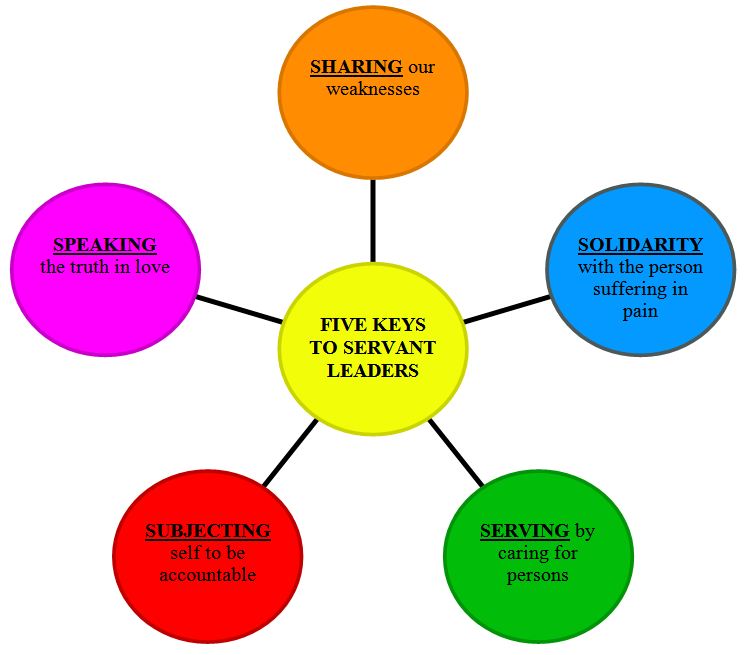
How to develop servant leaders? Use the Five Keys as a start.

How then do you develop Bible study leaders? In the light of 2 Timothy 3:10-11, we develop leaders beginning with ourselves. We may not take on an official role anytime yet. That does not mean we disqualify ourselves altogether. Why not consider living a life of a disciple first? Let me adapt Stacy Rinehart's five points about cultivating relationships by calling them keys on learning to be servant leaders.
  1. The Key of Sharing: "learn to risk sharing our weaknesses."
  2. The Key of Speaking: "say hard words in love to a brother."
  3. The Key of Subjecting Self: "to let someone really know our temptations and faults."
  4. The Key of Solidarity: "enter into someone else's pain."
  5. The Key of Serving: "care about the person and not the objective."

THOUGHT: "When we lament to God about the lack of servant leaders, and pray for more servant leaders, do not forget to look at the mirror, and ask God by saying: 'Here I am Lord, use me if you wish beginning with the five keys above.'"

sabbathwalk


Copyright by SabbathWalk. This devotional is sent to you free of charge. If you feel blessed or ministered to by SabbathWalk weekly devotionals, feel free to forward to friends, or to invite them to subscribe online at http://blog.sabbathwalk.org . You can also send me an email at cyap@sabbathwalk.org for comments or enquiries.

Friday, May 11, 2012

Meeting One Another's Needs?

TITLE: MEETING ONE ANOTHER'S NEEDS?
SCRIPTURE: Acts 4:34
Written by: Conrade Yap
Date: 12 May 2012

"There were no needy persons among them. For from time to time those who owned lands or houses sold them, brought the money from the sales." (Acts 4:34)

This is the concluding part of a 4-part series on Small Groups Ministry in the Church. The key point in this article is that meeting needs of members is not the primary responsibility of small groups. Meeting needs is very much secondary.

A) No Needy Among Them

Tucked in a corner of the book of Acts is this amazing little verse that says, "There were no needy persons among them." No needy people? You've got to be kidding!  In every Church I go to, every community I get involved with, the needs often exceed the supply. Some complain that the pastor hardly visits or calls on them. Others say that they feel neglected even on Sundays. Still, there are those who comment that the pastoral care in their community is grossly lacking. When they need some attention, the pastor is either unavailable or too busy.

My friends in the pastoral ministry regularly tell me that they needed a break, or a time away just to recuperate from an exhausting period of meeting the needs of their members and congregations. It is interesting that the very people who try to help parishioners rest in the Lord, themselves are often the recipients of their very own advice: The need to rest in God alone.

Meeting needs involve sharing and caring
B) Is It the Colony Instinct?

The book of Acts presents us with an interesting observation. Mind you, the early disciples in Acts are not rich people materially. They are often poor, and come from the lower ranks in society. Without a large personal bank account, or an enormous inheritance, they give whatever they have. If necessary, they sell their possessions to give to all who have need. Like worker bees individually collecting nectar from flowers, they return to the common hive to contribute to the food collection for the entire bee community. If anyone of us dares to look down on the collected nectar of each tiny bee, just take a look at the honeycomb.

I always believe that as a group, we meet one another's needs at different points of time. Not everyone of us is up or down all at the same time. There will always be some who is bubbly at some time. Others may be downcast at other times. In a group, there is a good chance that there will always be a mixture of the needy and the helper. Sometimes, we are needy. Other times we are able to help others. Together, we develop a caring and sharing community that ministers to one another at different points of time.

C) Weakness in the Small Group Model

In the book of Acts, meeting needs is not the primary responsibility of the pastor or leaders of the church. The responsibility lies in the entire community who essentially "were one in heart and mind." Dr Robert W. Kellemen points out a shrewd observation on the weakness of the small group model. While many churches use small groups to provide a care-and-share method, most people in the church (up to 50%) are not in small groups. Moreover, while the small group model works better than a mere dependence on the pastoral team, the small group system fizzles out over time due to fatigue or lack of training of small group leaders. He makes this observation.

"Unfortunately, many churches provide little equipping  in small-group leadership - especially  in the personal ministry of the Word of speaking the truth in love." (Robert Kellemen, Equipping Counselors for Your Church, Phillipsburg, NJ: P&R Publishing, 2011, 41)

Kellemen proposes something better than mere care-and-share small group networks. He recommends "equipping." This is the key role in any leadership.

D) Equipping is the Key for Growing Small Groups

How did the early Church in Acts learn to meet each other's needs so well? Cursory reading may well suggest that the people basically sell all their property and distribute all to anyone in need. That is quite correct. After all, the act of sharing and giving is an act of trust. When one gives away something, one trusts God to provide in other ways.

However, I see something more crucial in the act of meeting one another's needs. Before Acts 4:34, there is Acts 4:31.

"After they prayed, the place where there were meeting was shaken. And they were all filled with the Holy Spirit and spoke the word of God boldly." (Acts 4:31)

Bingo! Meeting another's needs is not simply a physical or emotional exercise. It originates from something very spiritual. More specifically, it originates from the Word of God, inspired by the work of the Holy Spirit. It is from the inspiration of the Spirit and spurred the early Church to preach and practice the Word of God boldly. In other words, meeting needs is not the primary role of any group. Meeting needs is a subset of something bigger: Bold proclamation of the Word.

This is where the equipping of the saints is highly crucial. Remember Jesus' reply to the tempter in Matthew 4:4? Responding to the temptation of turning stones into bread, Jesus answered, “It is written: ‘Man does not live on bread alone, but on every word that comes from the mouth of God.’”

E) The True Source of Meeting Needs

It is easy to be distracted by the needs around us (bread) that we forget the true source of help (Word). It is also tempting to try to touch every single life we meet with our modern church models, even small groups, substituting our primary responsibility (to proclaim God) with our secondary duties (meeting needs). Worse, while trying to meet needs as a primary focus, we end up trying to play the role of God. Can a blind lead the blind? Can the weary bring true rest to the needy? Are leaders really super-counselors that they have less needs than others?

No! If meeting needs is the key focus of any leader in the church, it is only a matter of time before that leader burns out. The key focus of a leader is to equip. There is no substitution for the Word of God. Kellemen adds,

"Our trainees need to feed on God's Word. They need to develop the conviction that the deepest questions of the human soul are God-questions, and that we find our deepest answers in God's Word." (Kellemen, Equipping Counselors, 207)

Let me repeat. Meeting the needs of members are secondary purposes of any small group.  That is the responsibility of the movement of the Holy Spirit. The primary responsibility is the Word of God. Our role is to equip one another in the Word, to disciple one another to become more like Christ. In prayer, in coming together, in sharing, we must always have the Word of God in our midst. Otherwise, we can easily become another statistic in the unending numbers of needy ones. As we fix our eyes on God, through the Word of God, our awareness of our neediness becomes strangely dim, in the light of God's glory and grace.


THOUGHT: Plant a word in the mind, and you will reap an act. Plant the act and you will reap a habit. Plant a habit and you will reap a character. Plant a character and you will reap a nature. Plant a nature and you will reap a destiny. (unknown)


sabbathwalk


Copyright by SabbathWalk. This devotional is sent to you free of charge. If you feel blessed or ministered to by SabbathWalk weekly devotionals, feel free to forward to friends, or to invite them to subscribe online at http://blog.sabbathwalk.org . You can also send me an email at cyap@sabbathwalk.org for comments or enquiries.

Wednesday, May 2, 2012

Four Kinds of Small Group Participants

TITLE: FOUR KINDS OF SMALL GROUP PARTICIPANTS
SCRIPTURE: Ephesians 5:1
Written by: Conrade Yap
Date: 3 Apr 2012

"Be imitators of God, therefore, as dearly loved children and live a life of love, just as Christ loved us and gave himself up for us as a fragrant offering and sacrifice to God." (Ephesians 5:1-2)
[This is Part 3 of a series on Small Group Ministry]

This week, an opinion poll suggests that "Canadians want everything for nothing." The statement is based on half the number of people surveyed who will vote against any politician who hikes taxes. While they are quick to demand for all things, from social welfare to personal benefits, they are extremely reticent, even vocal against paying for them. Paul Kershaw, a professor at the University of British Columbia observes that there are more people with an "anti-tax" sentiment who "want something for nothing." (Source: News1130.com, May 2nd, 2012)

Scary. If the report is true, that we are seeing a new generation of people who want everything, but unwilling to give anything, we are in trouble. In economic theory, the:re is what is called a "multiplier effect," where a stimulus leads to a knock-on effect that will generate a life of its own. Governments often provide the initial investment. A simple example goes like this. The Government issues a billion dollar contract to a big corporation to build a highway. This big corporation goes on to engage hundreds of other subcontractors and workers, who in turn benefit other entities like restaurants, hotels, transportation, logistics, school, and other miscellaneous sectors. In other words, one giant stimulus gets multiplied many fold. While there are other practical limits to such a theory, the idea is basically this: Giving stimulates economic activity or giving, taking, and sharing.

What if in our small groups in church, we see more of such people who give nothing but expect everything? There will be no multiplier effect. Worse, it becomes a shrinking effect when everybody takes and nobody gives. Continuing our series on small groups, this week, I like to suggest that there are at least four kinds of people in any small group environment. On the healthy end of the spectrum is a group called "healthy lambs" and "skinny goats" that nourish the whole community. On the unhealthy end, the appearance of "lamp-poles" and "leeches" suck away the life of the group. My main point in this article is that we should all strive to become the healthy kind, the healthy lamb. Let me first begin with the worst kind of participant, what I call the LEECH. Eeek!