Showing posts with label Preaching. Show all posts

Wednesday, October 28, 2015

"What's the Point?" or "Where is Christ?" (On Expository Preaching)

TITLE: WHAT'S THE POINT or WHERE IS CHRIST?
SCRIPTURE: Psalm 19:14
Written by: Dr Conrade Yap
Date: October 28th, 2015
May these words of my mouth and the meditation of my heart be pleasing in Your sight, LORD, my Rock and my Redeemer (Psalm 19:14)

Week after week, pastors prepare sermons. They spend time working through the biblical text. Those with knowledge of Greek and Hebrew go deep into the original wording and contexts. Others use the resources like the Bible study helps; commentaries; Bible concordances; and dictionaries; available to help them understand the ancient contexts. Good preachers will take more time to read the text meditatively, letting the Word speak to their hearts prior to doing anything else. If the Word has not touched the preacher, whatever that comes out of the preacher is usually more about the preacher rather than the Word.

Doing it week after week is tough. At times, preachers are tempted to just depend on the insights of others, put a few interesting stories or illustrations together, and then preach a sermon based on knowledge and other people’s advice. Like processed food, such sermons are like high-sugar calories that rather than solid food that strengthens the soul. The former puffs one up for a while before one begins to ask: “What’s the sermon point(s)?” It makes one wonder about the things said. When a sermon starts to look like spiritual advice, it is the beginning of the end for expository preaching.

I hear the question quite regularly when members ask: “What’s the point today?” Whether it was a regular preacher or a guest speaker, sometimes this question would pop up among believers having an after-sermon discussion, a lunch get-together, or an online interaction. Most times, people would just go about with their other activities, having heard the sermon, and feeling somewhat contented about checking off one item on the Sunday to-do list. In the meantime, the pastor had to reflect on his delivery and his content. Sometimes he would get brickbats from those who are offended by certain parts of the sermon. Other times, he would receive lots of verbal pleasantries like “Great sermon!” or “Thanks for the important message.”

The tragedy is not when a sermon is "boring."
The tragedy is when Christ is not preached.
Indeed, the mark of a great sermon is not about leaving in the minds of people, “What’s the point today” but to have people exclaiming: “I have encountered Jesus today!” This is what good expository preaching can do. It brings out the Word of God in a manner that glorifies Christ. The sad thing in today's churches is that we try to make things interesting for the audiences. We try our hand at entertainment. We pick illustrations that thrill. We add so much calories and unhealthy literary cholesterol that are worldly that we miss out on the pure spiritual food we need: Jesus Christ Himself. Preachers, please don’t be afraid to be “boring” in the sense that you are always preaching the same point: Jesus Christ. Preaching that is not about Christ and centered on Jesus is no preaching at all. Preachers must preach Christ, and not dispense spiritual advice.The tragedy is not when a sermon is deemed "boring." The tragedy is when Christ is not preached.

What is expository preaching?

Monday, June 1, 2015

Spiritual Vibrancy (People's Responses)

TITLE: SPIRITUAL VIBRANCY (People's Responses)
SCRIPTURE: John 15:5-8
Written by: Dr Conrade Yap
Date: June 1st, 2015

"5“I am the vine; you are the branches. If you remain in me and I in you, you will bear much fruit; apart from me you can do nothing. 6If you do not remain in me, you are like a branch that is thrown away and withers; such branches are picked up, thrown into the fire and burned. 7If you remain in me and my words remain in you, ask whatever you wish, and it will be done for you. 8This is to my Father’s glory, that you bear much fruit, showing yourselves to be my disciples." (John 15:5-8)

You have just heard a great sermon. You can sense that many people were touched. There is that feeling that going to Church is so good, so heartwarming, and so meaningful. Yet, after the refreshments and the fellowship hugs and kisses, come Monday, and things appear to be back to the usual grind. Familiar?

When we talk about the Christian life, it is not only about what happens during the Sunday service, but also what happens after the Sunday sermon. In my experience as a preacher, there are at least 4 types of respondents. The first type is the diplomatic type. These are the ones who tell you "Great sermon!" no matter how bad you thought your sermon was. They would smile at you and say nice things simply because you are God's servant and they had to give you the benefit of the doubt. This happens most of the time. It's a wonderful way to just be nice and not commit oneself to be defensive in any way. Unless the preacher was to ask: "Which part exactly did you find it great?"

The second are the skeptical who would either give you a quick piece of their mind about your message or send you some negative feedback sometime over the next few days. Friends of mine would appreciate not having any feedback at all within the first few hours after delivering a sermon. Giving one is already mentally and emotionally exhausting. It is not easy for the preacher to receive criticisms in a "weakened" state. While people may claim to speak the truth in love, the suggestion is to pray and wait until at least a 24-48 hours gap before giving a comment. Alternatively, congregation members can put down in writing via an email but keep it in DRAFT mode. Usually, over time, any negative feedback would be more nuanced and tampered with more grace. Shooting off the hip is never a good thing, especially when giving complaints.

The third are the nonchalant where no amount of pulpit feeding can ever get them to get outside their comfort zones. They are anchored on their concrete ground of self-affirmation and absolutely determined not to let anything interfere with their way of life. Maybe, their focus is simply on the refreshments and the fellowship time at the end of the service. Some may have dozed off for the most part of the sermon, so they do not have much to feedback about, little act on them.

The fourth are the ones who would keep the message in their hearts. They remember the key points and appreciate the way God has been speaking through the weeks. It can be a story shared or a quote said. It can be a passage that jumps out of the page like never before. When the seed of the Word is sown, the Spirit will aid in the germination and the people will respond accordingly.

Being fruitful is a mark of the Christian. More precisely, it is abiding in Jesus that we see Jesus bear fruit, and if necessary, through us. Very often, we hear teachings from the pulpit that we need to do this or to do that. We must practice kindness, show grace, or help the poor. We must give of our best to our work and be faithful in our service in society. What about putting the focus not on what we can do but on Jesus who is the enabler of all good works? What about living in such a way that our good work is a direct reflection of the goodness and love of God? What about acknowledging that without Christ, we can do nothing?

In a recent documentary entitled, "Godless," I was appalled at how some wayward Church denominations have lost their spiritual bearing and focus on God and chose human wisdom instead. One such church is West Hill United Church in Scarborough, Ontario, Canada that had changed "the glory of God" to the "glory of good." Led by an atheist minister called Gretta Vosper, the church no longer have any mention of God in their beliefs. They worship the good, the moral choices of human beings, and the nice fellowship of people who are there on the basis of moral good. They think that the living is more important than the believing, putting the focus on good works more than good traditional doctrine. This essentially means that they have come to a point where God, a Divine Supernatural Being, is no longer necessary for faith, and irrelevant to daily living.

How can any church call themselves "Church" when they do not worship God? By removing God altogether, they are surely on their own. John 15 is an urgent call for us to remember that no matter how skilled or how brilliant we are, we are never in control of the world. Try we may, venture forth we can, but to think we are the masters of our own fate will be a serious error. Whatever we do, we do in gratitude to the grace of God. The words to Job powerfully remind us about how limited we are.

4“Where were you when I laid the earth’s foundation? Tell me, if you understand. 5Who marked off its dimensions? Surely you know! Who stretched a measuring line across it? 6On what were its footings set, or who laid its cornerstone— 7while the morning stars sang together and all the angelsa shouted for joy? 8“Who shut up the sea behind doors when it burst forth from the womb, 9when I made the clouds its garment and wrapped it in thick darkness, 10when I fixed limits for it and set its doors and bars in place, 11when I said, ‘This far you may come and no farther; here is where your proud waves halt’?
I shudder to think about people who happen to boast their own abilities over God's providence. There are way too many unsolved puzzles in this world, let alone trying to take on Almighty God. Our responses to God's Word must never be in our own ability to produce fruit. It needs to be in being faithful to God, in remaining in God's grace, displayed in holiness and God's goodness. As we see this world more and more from God's perspective, practice living like Jesus, and to be responsive to the prompting of the Holy Spirit, we are on the way to fruitfulness.

Whatever good deeds we do in the Name of the Lord, make sure we acknowledge the One who is the true worker: God. This should be our response each Sunday, and every Sunday. The pulpit message preached must reside in our hearts to push us to abide in Christ, that Christ may bear fruit, and if necessary, through us.

THOUGHT: The fruit of the Christian life is not about good works. It is about God's work done as we abide in Christ and Christ in us. The visible sign of fruitfulness is when people see our good work and are pointed to the Source of all good works: God in Christ.

sabbathwalk

Copyright by SabbathWalk. This devotional is sent to you free of charge. If you feel blessed or ministered to by SabbathWalk weekly devotionals, feel free to forward to friends, or to invite them to subscribe online at http://blog.sabbathwalk.org . You can also send me an email at cyap@sabbathwalk.org for comments or inquiries. Note that views expressed are personal opinions of the author and do not necessarily represent the views of any person(s) or organization(s).

Tuesday, May 12, 2015

Spiritual Vibrancy (Preaching of the Word)

TITLE: SPIRITUAL VIBRANCY (Preaching of the Word)
SCRIPTURE: 2 Timothy 4:2
Written by: Dr Conrade Yap
Date: May 11th, 2015

"Preach the word; be prepared in season and out of season; correct, rebuke and encourage--with great patience and careful instruction." (2 Timothy 4:2)
Spiritual Vibrancy #1:
Biblical Preaching
Why is it that some churches are vibrant while others are simply dull? Is it because of the quality of the sermons? Or is it because of the warmth of the fellowship? Or is it because of something more practical like logistics, travel, or the convenience of something more unusual like parking? Starting this week, I like to launch a series of three reflections about spiritual vibrancy.

In conjunction with May 30th, 2015 as Global Outreach Day, I would like to say that vibrancy comes about with three things. First, the preaching of the Word. Second, the fellowship of the people. Third, the passion of outreach of the community. Both the second and third elements are active responses to the preaching and teaching of the Word of God. With the preaching of the Word, there needs to be a response. Without any responses, the Word remains within the four walls of churches and Christian communities who gather each week for worship.

The Preaching of the Word

One of the most striking traits in any revivals is the strong preaching of the Word. In the 18th Century (1731-1755), in what we know as the first great awakening in North America, we have men like Jonathan Edwards and George Whitefield, whose powerful preaching revitalized the entire society to go forth in faith and witness of the gospel of Christ. In the nineteenth century (1790-1840), there is the American spiritual awakening with Francis Asbury (Methodist), Henry Ward Beecher (Presbyterian), Charles Finney, and others who inspired a new generation with powerful preaching against the ills of society. Then comes the 20th Century (1850-1900) spiritual awakening, thanks to the Pentecostal movement and the Holiness movement. People like Dwight L. Moody and Ira Sankey were household names. In the 21st Century, we will all recognize the names of Billy Graham, Dr Martin Luther King Jr, and in our modern days, Chuck Swindoll, Rick Warren, and Tim Keller. Many of the megachurches all had one thing in common: Powerful preaching over the pulpit.


Thursday, February 26, 2015

Over The Head?

TITLE: OVER THE HEAD?
SCRIPTURE: Acts 17:11-12
Written by: Dr Conrade Yap
Date:  February 25th, 2015

"Now the Berean Jews were of more noble character than those in Thessalonica, for they received the message with great eagerness and examined the Scriptures every day to see if what Paul said was true. As a result, many of them believed, as did also a number of prominent Greek women and many Greek men." (Acts 17:11-12)

One common phrase I have heard over the years is the phrase, "over my head." Usually applied to situations in which the message cannot be understood, or too difficult for normal comprehension. Whether it is a professor at a University who used complex words to describe normal situations, or a pastor preaching something that is too difficult for the layperson to grasp, whenever there is a disconnect between the communicator and the recipient, these three words said it all: "Over the Head."

The next step is usually this: Forget it. Move on. Next item on the agenda. Maybe, lunch.

I really hope that will not be the end of the matter. I hope people would take time to ponder about whatever little they have heard. I hope they would ask around to see if anyone attending the same sermon or talk would have learned something. For to find ways to understand is the spirit of the Bereans at work.

1) Four Modern gods of Education

Friday, January 11, 2013

Making Good New Year Resolutions

TITLE: MAKING GOOD NEW YEAR RESOLUTIONS
SCRIPTURE: Ps 119:105
Written by: Dr Conrade Yap
Date: 11 January 2013

"Your word is a lamp to my feet and a light for my path." (Ps 119:105)

Last week, I preached the first sermon for the year, presenting a question to the congregation: "What kind of New Year resolutions should we make?" My intent is to encourage people to start the year well, with the Word of God as our guiding lamp and light. That we will be enlightened and illuminated by God's Word in our hearts, that we may shine forth for God in our good works.

Many things in the Bible can only be learned by obedience, not mere study/analysis.

Some people are sick of making resolutions, as they feel like they have never been able to keep it anyway. Others are nonchalant about it all, preferring to keep to the status quo. For them, no change is a good thing. Whatever it is, every New Year begins with some kind of a new hope and promise that things will be different this year. Will it not?

That depends. It depends on our attitude toward life. It depends on our determination to try again. For Christians, it is not simply about making or not making resolutions. It is about making good resolutions, especially the ones that gear toward becoming more Christlike and making disciples of all nations, starting with ourselves. It is with this that I challenged the congregation to adopt one or more of the five resolutions which I call GOOD resolutions. Here is a summary of the five.

#1 - LEAN ON GOD (Moving From Independence to Dependence)

In our high-achiever society, independence is a much sought after status. Children in particular can breathe a sigh of relief as they do not need to be dependent on their parents anymore when they reach the legal age for adulthood. Independence means freedom from parental restrictions or curfews. Independence is cool. Independence is liberation from rules and regulations.

Yet, spiritually, we cannot survive on our own. The problem with mankind is that they become too independent for their own good. They easily become selfish with their own ways. They become self-seeking creatures to the detriment of the community. Perhaps, we need to learn to grow more on dependence on God rather than the world. This is because spiritually we are lost without God.

Blessed are those who are aware of their own self-limitations and adopt a state of humility and depend more and more on God each day.

Resolution: I resolve to increasingly lean on God for all of my decision making. It can be through prayer, or through humility, I will refrain from self-seeking independence and progress toward God-dependent lifestyle.

#2 - LEARN GOD's WORD (From Sleepiness to Wakefulness)

The Scriptures urge us to depend on God, for God's Word is a lamp to our feet and a light to our path. When we encounter darkness, sometimes our natural reaction is to simply shrink back and wait until sunlight appears before venturing out. When we hear screams in the dark, we will huddle back in fear, unwilling to venture into the unknown, even when we hear a victim's scream a far distance away.

God's Word is a lamp and light that we have. In a world of darkness, God's Word can shine forth to help us see and to walk in the ways of the Lord. When we are spiritually sleepy, we miss out on the will of God for our lives. In Jared C. Wilson's "Gospel Wakefulness," one key reason why many Christians are spiritual sleepyheads is because the centrality of the gospel makes no sense to them. Often, the root of the problem lies in not knowing God's Word in the first place. That is why we need to keep God's Word in our hearts.

One way to do so is to embark on a Bible reading schedule that is regular, consistent, and disciplined.

Resolution: I resolve to read through big chunks of Scripture through the Year. I recommend reading through the New Testament and Isaiah. The plan is available here. 

#3 - LEAD WITH COURAGE (From Timidity to Courage)

Many of us are in positions of influence in our respective domains. Whether in the home, at work, or in our social circles, we all have a role to play. Timidity is often a problem with the attitude of our heart. It claims inability and questions why one needs to volunteer. It prefers to let others do it. It prefers to procrastinate.

Courage on the other hand requires us to live up to our own highest ideals. We are to lead with a positive attitude for God, rather than to shirk aside our responsibilities. Courage proclaims that with God's help, we can do it. It volunteers without being asked. It is open to God's prompting and call to do good works. It acknowledges that today may very well be the tomorrow we have been talking about yesterday. Perhaps, this year is the "next year" we have been talking about in the past few years!

Resolution: If not you now, then who? If not now, then when?

#4 - LEAP IN FAITH (From Passive to Active)

The Christian walk is not a path strewn with roses or easy-going walkways. Often, it requires a leap of faith. In fact, every step we take is a demonstration of what kind of faith we have. Like the lame man at the pools of Bethesda. Instead of simply accepting the lame excuse of not having other people to help him get into the pool on time, Jesus commands him to "Get up! Pick up your mat and walk!" (John 5:8)

It is so easy for us to toe the line, and to mind our own business even in the light of evil happening before our very eyes. Poverty levels remain high. Homelessness continues to be a problem. The gospel is still not preached to certain other places. What is our response to all of them? Do we simply complain to God that we have no resources or time to do that? Surely, if we make an effort to look for an opportunity to give and to serve, God will provide. Perhaps, the reason for our inaction is because we too have the lame excuse of the lame man of Bethesda. God is telling us: "Get up! Pick up your mat and walk!"

Resolution: Faith is responding to the prompting of the Holy Spirit in our hearts. Wake up! Pick up your courage and do something!

#5 - LEAVE OUR COMFORT ZONE (From lethargy to Lively)

For many Christians in many Churches, comfort is something we all enjoy having. So much so that once we are snuggled up in a nice corner in our favourite places, we become coccooned in. We wrap ourselves up with nice clothes and comfortable friends, that the world we live in becomes comfortable and hems us in. As a result, we are willing to live a lethargic Christian life as long as we maintain our levels of comfort.

Wrong! If we are serious about the gospel, we must not let comfort be our top priority. In fact, the early disciples of Christ could have comfortably remained in Jerusalem. Paul could have remained an influential solicitor in Rome. Yet, they press from Jerusalem toward Judea, Samaria, and many other parts of the world. Paul himself makes at least three missionary journeys.

The key is this. If we want to have spiritual vitality, we need to leave our comfort zone.

Resolution: I resolve to leave my comfort zone through risk taking and gospel sharing.

May a great year ahead, with making and keeping good resolutions, that Christ be glorified as we walk in the light of God's ways, and live in the power of God's Word.

THOUGHT: For far too many things in the Bible can only be learned by obedience. In fact, obedience brings understanding in ways no analysis can ever achieve.

sabbathwalk

Copyright by SabbathWalk. This devotional is sent to you free of charge. If you feel blessed or ministered to by SabbathWalk weekly devotionals, feel free to forward to friends, or to invite them to subscribe online at http://blog.sabbathwalk.org . You can also send me an email at cyap@sabbathwalk.org for comments or enquiries.

Thursday, October 11, 2012

Pillar #2 - Preaching Christ Through the Word

TITLE: PILLAR #2 - Preaching Christ Through the Word
SCRIPTURE: 2 Timothy 4:2
Written by: Dr Conrade Yap
Date: 11 October 2012

[This is Part Two of a series of four called "Pillars of the Church." For this week, I like to reflect on the place of preaching of the Word in the Church.]

 "Preach the Word; be prepared in season and out of season; correct, rebuke and encourage--with great patience and careful instruction." (2 Timothy 4:2)
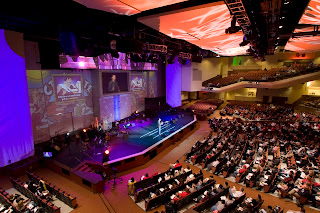
A Modern Megachurch: High-tech audio and visual,
powerful singing & speaking. Centrality of people experience
A) Focus of a Church Service via Symbols

What we see in front of a Church, often reveals the emphasis of the overall Church service. When we come into any Church, the symbols we see tells us what the leadership deems most important. If a Church has primarily a huge musical setup visibly in front, a full band, complete with speakers all with sen-surround effects, and lighting atmosphere, one suspects that singing, music and the user experience is the central focus of that Church. If the Church has a posh cinema-like environment, the core emphasis is the conduciveness of a worship environment to aid people experience. Some may even accuse these as entertainment places.

Communion: Centrality of Liturgy
Instead of modern high-tech arrangements, some churches prefer the expression of sacred liturgy and traditional images of the Cross, the Communion table, and the visible image of Jesus. In such a setup, one may see liturgy as the primary focus to aid the remembrance via tradition. Many Roman Catholic and Eastern Orthodox churches will have such levels of emphasis. Some Anglican churches will share some commonality like painted windows, visible crosses, and a familiar dome like architecture. In these places, the pulpit is often moved to the side, in order to avoid blocking any views of the cross or the communion elements. Two primary symbols represent liturgical tradition in the Protestant movement. The first is the Eucharist, or the Communion sacrament. Some churches break bread every week. Others do so once a month. Occasionally, there will be the sacrament of Baptism. The second primary symbol is the sacrament of the Word. It is to this sacrament that I like to focus on this week.

If the Church has a pulpit at the center in front of the sanctuary, one will not be wrong to see that the Word and the Preaching of the Word is the focus. This aids the preaching of the Word as central to the entire Church service. In some churches, there is a huge Bible on the pulpit to symbolize the centrality of the Word of God. The key task of the preacher is to proclaim Christ in preaching. The hearers are to respond to the prompting of the Holy Spirit as the Word falls on fertile hearts.

The Pulpit: Centrality of the Word

B) The Didache and Great Preachers

The first preacher of course is Jesus, followed by the Apostle Paul, with the twelve disciples. The Early Church uses the word didache (teaching and learning) as a key mark of the Church. This word is commonly used to denote the teachings of the twelve disciples after the Resurrection of Christ. While not considered canonical enough to be included in the New Testament, it is instructional enough to be one of the major pieces of literature used by the early Christian leaders to teach the people. 

The work of preaching remains one of the core pillars of the Church. Imagine a church service where the Word is not central but peripheral to the entire service. Will that be Church? That will not be a Church that is built on solid Rock of Christ. One of the best things to happen to Christianity is the Reformation movement during the 15th Century. Many of us will credit people like Martin Luther, John Calvin, or Ulrich Zwingli for bringing the reading of the Bible from the hands of the Church to the hands of the common people. Our modern evangelical movement is a beneficiary of this. In the 17th and 18th Century, we have powerful preachers like John Wesley, George Whitefield, Jonathan Edwards to bring about the first great awakening. In the 19th and 20th Century, we have even more great preachers such as Lyman Beecher, Charles Finney, Charles Spurgeon, and the dynamic Scottish, James S. Stewart. Key to the revival of the masses is powerful preaching. If we study Church history, we will quickly sense that the powerful preaching of the Word is key to reformation.

In modern America, we continue to see this trend of powerful preaching that leads to monumental growth in terms of Church attendance and spiritual revival. New York City has Tim Keller through the ministry of Redeemer Presbyterian Church. Southern California has Rick Warren through the Saddleback Church, Atlanta has Andy Stanley through North Point Community Church, and of course Massachusetts has Dr Haddon Robinson, who is my mentor for my doctoral thesis. One of the biggest reasons for anyone considering a theological education at Gordon-Conwell Theological Seminary is preaching. It is because of the conviction that the Word has to be proclaimed far and wide, clearly and accurately, that thousands of ministers have gone through training and teaching on preaching. Especially through Gordon-Conwell.

C) The Preacher's 1st Task: Listening to the Word

One of Dr Robinson's conviction is this: "Until the biblical text has preached to me, I’m not ready to preach the biblical text to the congregation." This is the single most important thing that must happen to any preacher, before he can preach. I spend hours on the text weeks before I preach. I do not just read it. I think of it. I ponder over it. I dig into the text to understand the original meaning. This is the work of exegesis, where the original language is studied, the cultural context is drawn out, and the meaning of the passage is relived. This calls for patient waiting. The easiest way to understand spiritual listening is to allow the Word to shape our hearts. We hear the Word. We obey the Word.
  • If I am preaching on love, consider how I have loved.
  • If I am preaching on patience, consider how I have been patient.
  • If I am preaching on idolatry, consider my idols. 
  • If I am preaching about an Old Testament text, consider how it looks like from New Testament perspectives, beginning with me.
Robert Mulholland Jr says that Christian spiritual formation is "the process of being conformed to the image of Christ for the sake of others." I have always believed that the hardest part of preaching is not the preparation of the sermon contents or the delivery styles. The toughest is the preparation of the heart. This is why listening is the critical first step.

D) The Preacher's 2nd Task: Learning from the Word

Typically on a preaching week, I will first read the passage. I try to remember the key points of the passage, asking what the big idea is in the text. I use a dual-directional probe.
  • Who is it for (ancient) and how is it applicable (contemporary)?
  • What is it about (ancient) and what does it mean now (contemporary)?
  • Why is the passage written (ancient) and why is it relevant now (contemporary)?
  • Where and how (ancient) and where and when (contemporary)? ...
I supplement my preparation with a recollection on the books I have been reading, asking the Holy Spirit to show me something, after considering the views of so many different brothers and sisters who have shared their gifts of knowledge through books and literature. If there is any panic day, Saturday will usually be the one. I consider the verses and the things happening in the Church that week. I pray for people. I then put together my research and ask the Spirit to show me the key idea or ideas in the text. Sometimes, I will have prepared at least three different versions, and decide which version on the Sunday morning itself. Only when the preacher has become a learner himself, can he move on the process of preaching.

E) The Preacher's 3rd Task: Letting the Spirit Help Us Proclaim the Word

Finally, when we preach, content is important. Delivery is equally important. However, they can never substitute for the unction of the Spirit. Without the Spirit, it is plain speaking. With the Spirit, it is anointed preaching. Preaching is tough not because of the need to overcome stage-frights, but because of the necessity to win over flesh fights. It is one thing to preach the gospel for God's sake. It is yet another to preach for the sake of making oneself look good, at the expense of God. The Scottish dynamic preacher, James S. Stewart argues for the preacher to be "possessed" by the Gospel and captured by the Spirit to preach the Word of Truth. He writes:

"There is, therefore, no place to-day for a Church that is not aflame with the Spirit who is the Lord and Giver of life, nor any value in a theology which is not passionate missionary. If there throbs through the Church the vitality of a living union with Christ - and apart from this the Church has no claim to exist, no right to preach, it is merely cumbering the ground - if the Church can indeed say 'It is not I who live, it is Christ who lives in me,' then the dark demonic forces of the age have met their match, and the thrust of life is stronger than the thrust of death." (James S. Stewart, A Faith to Proclaim, Vancouver, BC: Regent College Publishing, 2002, p11-12)
Proclaiming the Word through preaching is a core pillar of any church. This is one more reason why we ought to pray for our pastors and our preachers. We need to give them time to prepare, to study, and to get ready for the message each week. We need to pray for them, that they be protected against the temptations of the flesh toward pride, or the deception of the evil one toward other forms of idolatry. We need to give them as much support as possible, by being readers and obedient hearers of the Word. Perhaps, we can also share of our learning with preachers, so we too can be a part of this very important ministry of the Church. For the rest of us, suffice to say, pray for your preachers each week, and every week. Feedback to them regularly. You are only helping to strengthen the ministry of the Word in Pillar #2. One more thing. When the Word is preached well, while growing numbers are important, do not forget something much more critical, that our lives are changed by God's Word.

THOUGHT: "Great preachers are good communicators, but good communicators are not necessarily good preachers. And the difference is authority. My definition of preaching is it is a word from God for the people at a moment in history." (Crawford Loritts, Campus Crusade)
May the Lord grant us more preachers who preach in the Power of the Spirit and proclaim the glory of Christ. For the kingdom.

sabbathwalk

Copyright by SabbathWalk. This devotional is sent to you free of charge. If you feel blessed or ministered to by SabbathWalk weekly devotionals, feel free to forward to friends, or to invite them to subscribe online at http://blog.sabbathwalk.org . You can also send me an email at cyap@sabbathwalk.org for comments or enquiries.

Tuesday, May 17, 2011

Four Critical Moods in Preaching

TITLE: THE FOUR CRITICAL MOODS IN PREACHING
Written by: Conrade Yap
Date: 17 May 2011
"Preach the Word; be prepared in season and out of season; correct, rebuke and encourage--with great patience and careful instruction." (2 Tim 4:2)

MAIN POINT: This week's article is a note to preachers, in particular myself, that preaching requires four critical moods.

I love to preach. Having gone through theological training, and being schooled by some of the best preachers in the world, I still feel frequently inadequate. The irony is that when I feel confident, and when I think I have preached well, there seem to be very little effect on the people. On the other hand, when I feel weak, and inadequate after my preaching, strangely, lives are touched. Preaching can be a humbling experience. I have a world-class professor as my mentor. He has been voted one of the top 12 best preachers in North America. Sitting through his class is an experience in itself. With great training comes a heavy responsibility.

I write the following to remind myself about the FOUR critical moods needed before, during, and after preaching. If you are a preacher, or one who may be called upon from time to time to preach the gospel, feel free to listen in. You may want to share this with your pastor, leader or anyone who from time to time, are called to preach.

Tuesday, December 15, 2009

Preaching the Word in Word and Indeed

TITLE: Preach the Word in Word and Indeed
“Preach the Word; be prepared in season and out of season; correct, rebuke and encourage—with great patience and careful instruction.” (2 Tim 4:2, NIV)
I love to preach. Whenever the text is opened, there is an inexplicable joy and enthusiasm to dive in, to dig in, and to swim in the Scriptures. While I do not preach every week, I am constantly in a preparation mode. I read widely. I write. I reflect. I blog. For I believe in Paul’s exhortation to young Timothy above, to be ready in season and out of season. That is why when I am asked to preach, my preparation frequently leads me to 3 or more versions of a sermon. It can look like a 3-in-1 gift to the church. I like to see it as offering 3 different versions to God and pray that the Holy Spirit will lead and guide me to select the most appropriate version. Such a version needs to be the one that answers three needs; truthfulness of my heart, appropriate to the congregation, and glorifying to God.

This is no easy task. In fact, the key to preaching is not in a good pulpit performance but a humble heart. The pulpit ministry can become a great temptation to show off one’s oratory skills and public speaking capabilities. Sometimes, we can confuse the pulpit with motivational talks. No! The pulpit is far too sacred to be secularized. It is far too precious to be diluted into worldly stories and motivational speeches. Some preachers think that telling stories and getting people’s attention is far more important. Yet, preachers of the Word of God are not called to be Sunday entertainers, but worshipers. If one does not worship well, how can one preach well?

Bored on Sundays in a Culture of Entertainment
The word ‘worship’ has become so widely used that its meaning has been diluted. We use it for singing songs. We use it in our printed bulletins. We use it to symbolize a Sunday gathering. A lack of understanding of true worship, easily tempts us to equate worship with another program to satisfy self. We need to remind ourselves that in worship, it’s not about us. It’s all about God. It is about giving God the credit, and to learn to give thanks and praise to a worthy God. Like Matt Redman’s popular song,
“It’s all about You, Jesus.” which brings us to a heart of worship.
Unfortunately for many, our listening ability has been sharply curtailed due to unhealthy expectations we carry over unwittingly from the TV/movies to the pulpit. Watching TV, Youtube on the Internet and movies, 7 days a week can inadvertently create in us an entertainment mentality. We then carry this with us even as we sit on the pews each Sunday. If the preacher tells a nice story, we sit up and listen. When the preacher goes to the hard task of deciphering the biblical languages, we yawn and doze off in boredom. Toward the end of the service, we wonder what happened. One of the common complaints I have heard is that preachers speak above one's head. My question, is it solely the preacher's fault?
A joke was told about a man who slept through a boring sermon. The preacher, feeling a little indignant decided to embarrass the man. So he asks all who wants to go to heaven to stand up. Everyone did except for the snoring man. As members of the congregation begins to sit, the preacher asks another question, “Those of you who thinks he will go to hell, please stand up.” The dazed man suddenly wakes up and said: “Pastor, I am not sure about what we are voting here, but it seems like only the two of us are in agreement.”
Anybody can tell stories and jokes, but not everyone can preach in a manner that leads all toward worship. The pulpit ministry is essentially a ministry to worship God by letting God’s word shine forth into the hearts of all, including the preacher. I will even venture to argue that in any preaching situation, the one most blessed is often the preacher himself or herself. From experience, the biggest challenge in preaching is not the sermon material but the heart. It is the preparation of the heart that is most difficult. It is the preparation of the heart that is most treacherous. It is the preparation of the heart that most accurately determines who we are worshiping on Sunday. It is the preparation of the heart that tells us whether we are working for God’s glory or the preacher’s own reputation.

I remember one sermon which I was particularly proud of. Having put in many hours to prepare, I printed them out and practiced many times including the hours leading up to the Sunday sermon time. At the end of the sermon, I felt empty. I felt like I have merely performed an act. I felt while I have delivered professionally, I have worshiped miserably. The feeling is terrible, that I dare attempt to grab what is rightfully God’s and to chase after positive affirmations and feedback from others, to call it mine.

At other times, I will faithfully prepare my sermon. Despite a weak delivery, I will feel glad and peaceful within, knowing that the Lord’s power is made perfect in my weakness. I love this situation, where I know for sure, that if the parishioners were blessed, it is definitely not my work, but the power of the Holy Spirit. This is a strange journey of a preacher. God has blessed me with a desire to preach, and to do so as faithfully as possible. Knowing my passion, He has even provided me a preaching mentor, Dr Haddon Robinson, previously named one of America’s Top Preachers. He is also my current doctoral dissertation advisor. I have benefited greatly simply by listening to his wise experience.

Preaching is not a Ministry but an Attitude
Some say that entering seminary is essentially learning to minister full-time in an official ministerial capacity. While true in some ways, I think it is far too narrow a perspective. Going into seminary or Bible schools is not simply preparing one to minister. It is simply a phase of one’s walk with God. One of my Regent professors, Dr Paul Stevens recently gave a talk in Singapore entitled “Why Theological Education Is Too Good To Be Reserved For Pastors,” Stevens argues that theological education is for everybody. He proposes the radical idea that ministry is never to be divided into laity and clergy. In the light of the people of God, doing ministry is essentially the people of God, ministering together to the people of God.

I share this same ethos. After all, I have spent 4 years at Regent College, still one of the best and rewarding years of all of my life. I have never learned so much, from so many people before. This leads me to believe that preaching is not so much a ministry, but an attitude. This interpretation is consistent with Paul’s exhortation to Timothy to preach the word in season and out of season. Some of us may not be called to pulpit preaching. Neither is everyone called to teach from the Word like a Bible school teacher. However, all are called to let their own Christian testimonies preach God’s Word in truth and in love. Let God’s Word shine through our thoughts, our words and our deeds.

What About the Lay?
As much as the preacher needs to come with a humble heart, the parishioners and church goer needs to play their part too. Below are some of my suggestions. I call it P.E.A.C.E of heart.
  • Be PURPOSEFUL in preparing our heart for worship. Know the limits of our bodies. Maybe, we need to begin on Saturday evening. How about sleeping early, and waking up early to pray?
  • Be EARLY in Church. Sometimes, our impatience and restless minds come from a harried morning rush, and a hurried soul. This makes worship of God hard, as one is still trying to calm down.
  • Be ATTENTIVE to the needs of family members or friends. As a father, I struggle with this, and at times have allowed my unhappiness over punctuality affect the worshiping mood of my family. The key is communicate one’s plans to family members early.
  • Be CAREFREE. In preparing a heart of worship, we need to let go of distractions. One way is to practice the Sabbath. For example, every Saturday night from 6pm to 6 pm the next day, I will go on a computer fast.
  • Be ENCOURAGING. When we get to Church, say thanks to the ushers, the musicians, the pastor or even the one preparing coffee. A word of encouragement not only makes these servants feel acknowledged, it makes them feel loved.
In summary, the ministry of preaching is an attitude that covers both the preacher and the listeners. Together, we can worship God in Spirit and in truth. Preach the word in season and out of season, to correct, to rebuke and to encourage one another in the Lord. If we do this, this will be the best worship we can give to God on any given Sunday.
"Worship changes the worshiper into the image of the One worshiped." (Jack Hayford)

sabbathwalk


Copyright by SabbathWalk. This devotional is sent to you free of charge. If you feel blessed or ministered to by SabbathWalk weekly devotionals, feel free to forward to friends, or to invite them to subscribe online at http://blog.sabbathwalk.org/ . You can also send me an email at cyap@sabbathwalk.org for comments or enquiries.